
Cyathus olla
Taxonomy
Main synonym
Common names
Ciato atrompetado, habia leun, trompeta petita.
Geographic references:
Interactive map with data from GBIF.



Morphological Features:
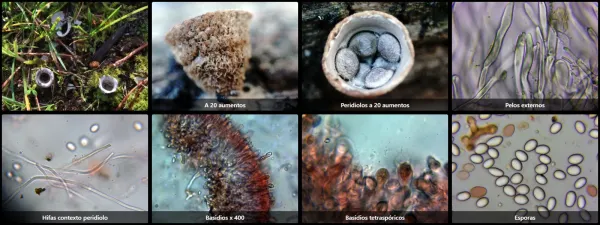
Fruiting body cylindrical or tubular in shape during its early stages, covered at the apex by a lid-like structure called an epifragma, which is whitish or occasionally slightly yellowish. As the fungus matures, the epifragma ruptures and the specimen assumes a typical bird's nest or cup shape, reaching up to 1.5 cm in height and approximately 1 cm in diameter. It comprises three distinct parts: the external surface or exopercidium is basically gray and tomentose, though it may exhibit brownish or toasted hues; however, the endopercidium is smooth, lacking folds or striations, and more distinctly gray.
Gleba composed of small, egg-like structures called peridioles; these constitute the fertile portion of the fruiting body and house the spores and basidia internally. They are typically gray, sometimes nearly black, and lenticular in shape. These peridioles measure approximately 3 mm in size and remain attached to the endopercidium by a rather tough filament (funiculus); the number of peridioles per specimen is a variable character.
Stipe absent; the species is sessile.
Flesh insignificant, with no notable odor or taste.
Habitat:
Gregarious species, fruiting in more or less numerous clusters, colonizing nutrient-rich soils or directly on wood or various woody debris. It is a common species that can be found practically year-round, perhaps except during winter.
Observations:
With this species, we complete the most common nidulariaceous fungi found in our environment: the Cyathus trilogy, which includes the species Cyathus stercoreus, perhaps the most similar to the present one, being more hairy and coprophilous in habitat; Cyathus striatus, with a striated endopercidium; and Crucibulum laeve, the quintessential bird's nest fungus, yellowish-ochre in color and exhibiting clear structural differences in the epifragma and exopercidium.