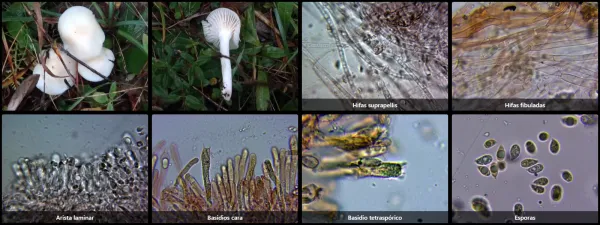
Cuphophyllus virgineus
Taxonomy
Main synonym
Common names
Higróforo niveo, ezko elurzuri, mocosa blanca petita.
Geographic references:
Interactive map with data from GBIF.




Morphological Features:
Pileus slightly or not at all viscid and small; most specimens of this species do not reach 5 cm in diameter, with sizes of 2 to 3 cm being very common. Initially convex, it gradually flattens, becoming obtusely umbonate at this stage, and eventually becomes somewhat infundibuliform when old. Young specimens are pure white, later turning ivory-cream, especially in the central zone, and may exhibit pinkish tinges when fully mature. The margin is involute during the early developmental stage, later becoming very thin and regular, appearing radially striate by transparency when adequately hydrated.
Lamellae markedly decurrent, white in color, widely spaced, and featuring some interveins. They are quite thick and appear waxy, but do not feel so to the touch.
Stipe more or less cylindrical, white in color; it may be slightly attenuated at the base and is proportionate to the pileus. Solid in young specimens, it becomes cavernous with age, and reddish or pinkish tinges are commonly observed near the base.
Flesh very fragile and white in color, becoming watery with age; odor is practically absent, and taste is sweet and mild.
Habitat:
It may occur in grassy woodland clearings and along road edges, but undoubtedly appears most profusely in meadows and pasturelands. It typically fruits in large groups of numerous individuals during the autumn months, and also early winter at lower elevations. It should be classified as a frequent species.
Observations:
When young, it is a fine and delicate edible; this cold-tolerant species is characteristic of meadows. Small individuals were traditionally identified as Hygrophorus niveus, although it has now been confirmed that only a single taxon exists. Camarophyllus fuscescens is also regarded merely as a variety of the species described here. It may be confused with Hygrocybe russocoriacea, which possesses a pronounced leather-like odor.