
Cuphophyllus pratensis
Taxonomy
Main synonym
Common names
Higróforo de los prados.
Geographic references:
Interactive map with data from GBIF.
Morphological Features:
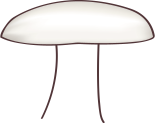
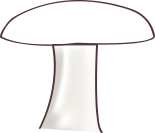
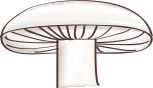
Pileus 3 to 8 cm, initially globose, becoming plane in mature specimens; fairly uniformly orange but tending to fade, non-viscid, with a very thin, acute margin.
Lamellae widely spaced, broad and decurrent on the stipe, slightly paler than the pileus.
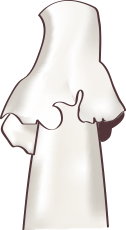
Stipe cylindrical and solid, tapering towards the base, fibrillose, very pale cream-orange.
Flesh whitish, thick but not very firm, rather fragile, with a mild and unremarkable odor and taste.
Habitat:
As its name indicates, it is a species exclusive to meadows or grasslands, appearing in mid-autumn and persisting into early winter. It is frequent along the Cantabrian coastal strip, but not so in other regions.
Observations:
It is an edible species, appealing due to its pleasant appearance, but not particularly choice. Given its coloration and habitat, it is not easily confused with other species. Although some woodland species share a certain resemblance, such as Hygrophorus nemoreus or Hygrophorus arbustivus, both are typically found under various broad-leaved trees.