
Cuphophyllus flavipes
Taxonomy
Main synonym
Common names
Hygróforo de pie amarillento.
Geographic references:
Interactive map with data from GBIF.
Morphological Features:
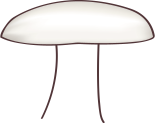
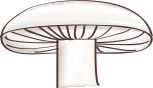
Pileus of small dimensions, between 2 and 4 cm, gray with distinct violaceous tints, and occasionally even matte pink tones; initially somewhat campanulate, though typically encountered as convex or flattened. Cuticle slightly viscid in wet conditions, otherwise subdry, smooth, weakly to not at all striate.
Lamellae fairly uniform violaceous-gray, widely spaced with intercalated lamellulae; typically decurrent on the stipe and notably thick for such a small basidiocarp.
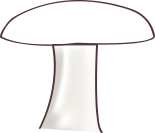
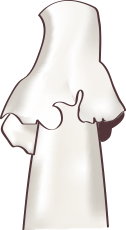
Stipe cylindrical and longer than the pileus diameter, pale gray or cream-colored, yellowing at the base, generally curved.
Flesh grayish, thin and soft, with a faint odor and a slightly acrid taste when raw.
Habitat:
Occurs during autumn in lowland meadows and grasslands on nitrophilous substrates. This mushroom is very infrequent, scarcely recorded in many regions, yet locally common in our area.
Observations:
Although listed as edible, this hygrophoroid mushroom holds no particular culinary value. Its violet coloration is exceptional among its congeners; thus, we consider it a species that is straightforward to identify yet challenging to locate. More striking in color and with a pointed conical pileus is Hygrocybe caliptriformis, which can be readily distinguished from the species described herein.