
Crucibulum laeve
Taxonomy
Main synonym
Common names
Crucibulo común, hongo nido, habia hori, niuet.
Geographic references:
Interactive map with data from GBIF.




Morphological Features:
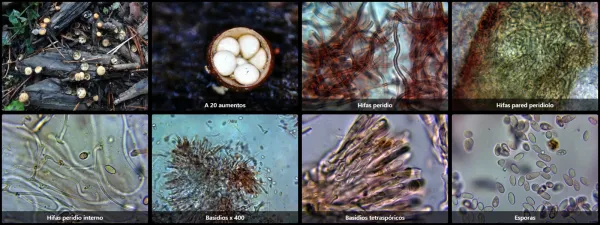
Fruiting body with an average diameter ranging from 0.5 to 1 cm; exceptionally, specimens with diameters approaching 2 cm have been collected, with a similar height. In its early developmental stage, it resembles a small pastry; the fruiting body is more or less turbinate or urceolate, subsequently developing into its characteristic bird's-nest form. The enveloping peridium is straw-yellow, tomentose, and consists of a separable layer. The inner surface is initially yellowish-ochre but becomes distinctly grayish with age; it is smooth and lacks striations. In young specimens, the entire upper surface is covered by a whitish to yellowish membrane known as the epifragm, which gradually disintegrates circumferentially until it disappears, exposing the gleba.
Gleba consisting of a gelatinous fluid that envelops a series of lens-shaped peridioles. As it matures, the fluid dissipates, exposing approximately 8 to 12 whitish to cream-colored peridioles. These peridioles are attached to the inner surface via a funiculus.
Stipe absent; the species is sessile.
Flesh indistinct, lacking any noteworthy odor or taste.
Habitat:
This species fruits on diverse substrates, including twigs, woody or herbaceous plant debris, as well as dung. It is a common and abundant species that can fruit from spring through late autumn. It generally appears in more or less numerous groups.
Observations:
This species is characterized by its bird's-nest morphology, yellowish coloration, and whitish peridioles. It may be confused with species of the genus Cyathus, such as Cyathus stercoreus, which exhibits an exclusively coprophilous habitat, a brown pilose peridium, and a white to grayish epifragm. A less common but notably similar species is Nidularia deformis, which is smaller and possesses more numerous, brownish, free peridioles lacking a funiculus.