
Crinipellis scabella
Taxonomy
Main synonym
Common names
Not available
Geographic references:
Interactive map with data from GBIF.
Morphological Features:
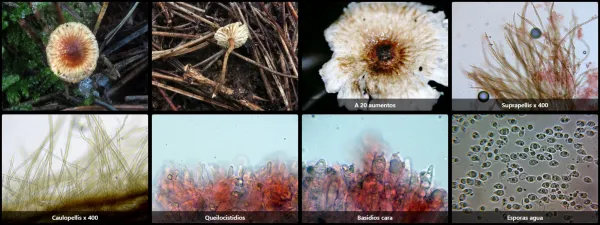
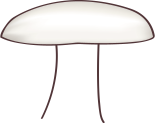
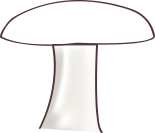
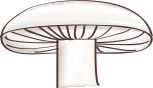
Pileus small in size; the diameter of a mature specimen ranges from a few millimeters to 1.5 cm. Initially somewhat campanulate, it becomes convex and finally flattens out, while consistently retaining a small but well-defined umbo at the center. The cuticle is somewhat pilose in young specimens, always radially fibrillose, with reddish or reddish-brown fibrils on a lighter, creamy or whitish background. With age, the whitish or creamy color tends to predominate, leaving only the central area reddish-brown. The margin is not striate but irregularly rugose and covered with hairs, more prominently so in young specimens.
Lamellae adnate, not crowded, moderately spaced, ventricose, and whitish.
Stipe disproportionately elongated compared to the pileus, chestnut-brown in color, covered with fine hairs or tomentose. It is often longitudinally sulcate, and despite its tenacious consistency, it is fistulous.
Flesh thin and scanty, whitish in color, quite firm, especially in the stipe. Its odor is faint, and its taste is sweet and mild.
Habitat:
It is primarily an autumnal species, sometimes late-season, fruiting on various herbaceous remains and grass stems in all types of woodlands. It easily goes unnoticed due to its small size; however, it is a fairly common mushroom with gregarious growth habits.
Observations:
A small mushroom growing in clusters on grass, characterized by its central umbo, which retains a reddish-brown color throughout development while the rest of the pileus fades. Crinipellis corticalis is nearly identical, distinguishable by being more pilose, fruiting on dead wood, as well as by its amygdaliform spores. It can also be confused with several Marasmius species, such as Marasmius cohaerens, which has a more ochraceous pileus and a striate margin.