
Crepidotus variabilis
Taxonomy
Main synonym
Common names
Crepidoto variable, txirla arrunt.
Geographic references:
Interactive map with data from GBIF.
Morphological Features:
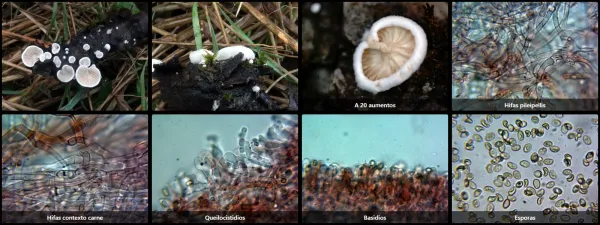
Pileus small, adult specimens do not exceed 3 cm in diameter, with a characteristic shape resembling fans that open through 360 degrees. The surface is white, occasionally with creamy or grayish tints, slightly tomentose or felted, especially in young specimens and towards the margin, becoming smoother with age. The margin is almost always incurved and irregularly undulate. It is typical for this species not to form a perfect circle, but rather an opening is visible from the end of the disc to the point of attachment to the substrate.
Lamellae adnate and ventricose, arranged in a markedly radial pattern, extending from the point of attachment to the substrate towards the margin. They are widely spaced with some lamellulae, whitish in young individuals, evolving to light ocher tones, almost flesh-colored, and finally becoming entirely ocher.
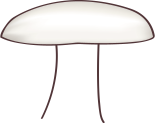
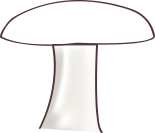
Stipe lateral and very rudimentary in young specimens, later absent; when present, it is the same color as the pileus.
Flesh scant and soft, becoming thinner towards the pileal margin, whitish in color. Odor distinctly fungal but not particularly pleasant; taste insignificant.
Habitat:
A very frequent and widespread species that may appear practically year-round. Fruiting on fallen branches and, in general, on all types of dead wood, without special preference for a particular tree species; it also occurs on woody debris from shrubs or herbaceous stems.
Observations:
This is the best-known species of the genus Crepidotus, a genus characterized by wood-inhabiting species with a more or less fan-shaped habit, a practically absent stipe, and a brown spore print, which imparts ocher tones to the lamellae upon maturation. Crepidotus cesatti is a very similar species, differing in its nearly round and spinulose spores. Crepidotus applanatus also bears some resemblance, but possesses much smaller globose spores than those of the species described here.