
Crepidotus crocophyllus
Taxonomy
Main synonym
Common names
Not available
Geographic references:
Interactive map with data from GBIF.


Morphological Features:
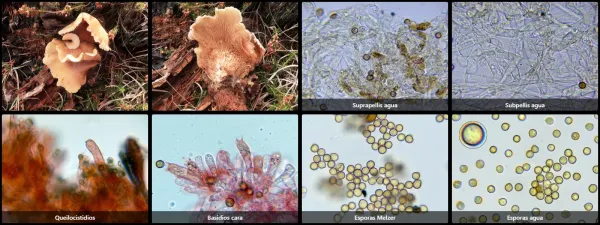
Pileus large for its genus, reaching up to 5 cm in width, extending approximately 3 cm from the attachment point, and measuring half a centimeter in thickness at its thickest part, which corresponds to the area of attachment to the substrate. It projects in a shell-like, flabelliform, or reniform shape, initially convex and later flattening out. Its surface has a whitish or slightly yellowish background, but an ocre color predominates due to being covered with closed scales of that hue and being fibrillose; these fibers are especially noticeable near the margin and more abundant near the point of attachment to the substrate, where they also acquire a yellowish or saffron tint.
Lamellae radiating from the point of attachment toward the margin, as in all *Crepidotus* species, rather crowded and of varying lengths. When young, they may be whitish, yellow, or orange, but always turn ocre with spore maturation; this color variability led to the description of different taxa within section fulvifibrillosi, which recent studies indicate are synonyms of this same species.
Stipe absent; this is a sessile species.
Flesh soft and thin, somewhat elastic, whitish in color, with a damp odor and a slightly astringent taste.
Habitat:
A species that forms individual fruit bodies with solitary or occasionally gregarious growth. Fruifies on dead wood of various trees; within our area of study, it is an uncommon species on broadleaf trees and even rarer on conifer wood. Our collection was made in May on a fallen branch of holm oak (Quercus ilex).
Observations:
A considerable-sized *Crepidotus* species characterized by its fibrillose and scaly cuticle, as well as the variability in lamellar color, which can be whitish, yellow, or orange when young. *Crepidotus autochthonus* is of similar size, but its cuticle is smooth and its lamellae never adopt striking colors. *Crepidotus mollis* is somewhat smaller, with cream-colored lamellae and elliptical spores.