Crepidotus autochthonus
Taxonomy
Main synonym
Common names
Not available
Geographic references:
Interactive map with data from GBIF.




Morphological Features:
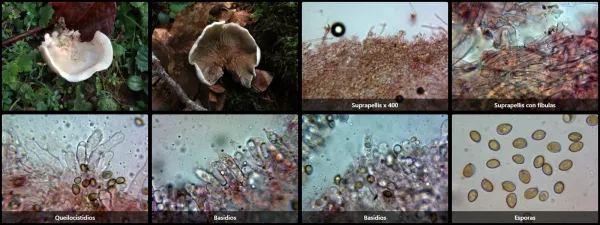
Pileus fan-shaped or shell-shaped, with highly variable dimensions; it can reach up to 2 cm in extension and 4 cm in width, while its thickness rarely exceeds 1 cm. When young, it is white, turning creamy with age, and developing a yellowish tinge in older specimens. Its surface bears a fine felted layer when young, which tends to disappear with age, leaving it smooth and glabrous. It is not highly hygrophanous; consequently, the margin is typically not translucently striate. Unlike other species in the genus, it lacks a gelatinous layer.
Lamellae divergent, arising from the point of attachment to the substrate, somewhat irregular in arrangement, distant, and interspersed with lamellulae. Pale when young, but rapidly turning ochraceous as spores of this color are deposited upon them. The margins are typically lighter in color and fimbriate.
Stipe highly rudimentary or absent; the fruitbody is generally attached directly to the substrate.
Flesh thin, white, with a gummy texture and slightly elastic; sweet-tasting, with a weak radish-like odor.
Habitat:
This species typically fruits in gregarious clusters on decaying wood of various tree species, or on fallen or buried branches. It is a rare species that may fruit in both spring and autumn.
Observations:
The genus Crepidotus comprises shell- or fan-shaped species with a saprotrophic lifestyle, lamellae that attach at the point of substrate contact, and an ochraceous spore print. Macroscopic differentiation between species is difficult. The species presented here belongs to the group lacking a gelatinous layer and possessing a more or less smooth cuticle; it is somewhat larger than other species in the genus. The most well-known is Crepidotus variabilis, which is considerably smaller.