Craterellus tubaeformis
Taxonomy
Main synonym
Common names
Rebozuelo atrompetado, saltsa-perretxiko horilun.
Geographic references:
Interactive map with data from GBIF.





Morphological Features:
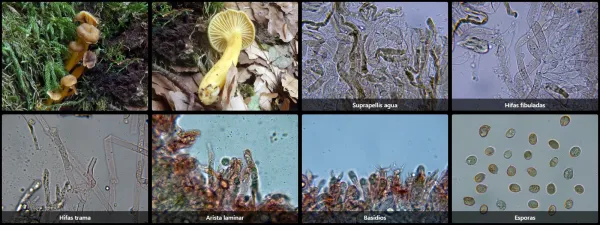
Pileus about 5 cm in diameter at maturity, deeply umbilicate and plane, although the central depression deepens with age and extends into the stipe. Color is somewhat variable, generally brownish with yellowish or ochraceous tints. The margin is usually more yellowish and irregularly wavy and incurved.
Lamellae absent; the hymenium consists of well-defined, forked ridges that are widely spaced and decurrent on the stipe. They are grayish in color, but the smooth background is more yellowish.
Stipe central and cylindrical, laterally compressed or grooved, entirely smooth, dull yellow in color, sometimes even grayish.
Flesh scanty, very thin and flexible, firmer in the stipe, pale yellow in color. Odor reminiscent of dampness or mold, taste sweet and not unpleasant.
Habitat:
Fruiting occurs in autumn, and it fruits equally well in deciduous or coniferous forests; we have found it in pine stands and beechwoods. It grows primarily on moss or soil humus, in a gregarious manner.
Observations:
It is a good edible, although in our opinion of lower quality than Craterellus lutescens, with which it is normally confused. The most notable difference lies in the hymenium, which has clearly defined ridges in the species described here, a feature lacking in the other. Another possible confusion is with Cantharellus melanoxeros, which has a more yellowish pileus and flesh that darkens.