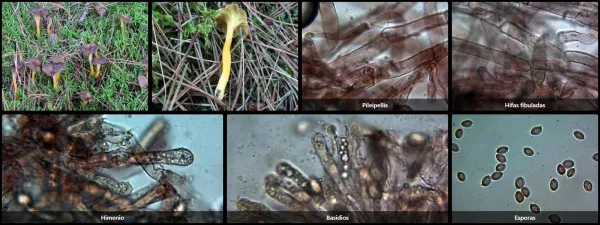
Craterellus lutescens
Taxonomy
Main synonym
Common names
Rebozuelo anaranjado, trompeta amarilla, angula de monte, saltsa-perretxiko hori, camagroc.
Geographic references:
Interactive map with data from GBIF.





Morphological Features:
Pileus approximately 5 cm in diameter at maturity, infundibuliform or plane, but with a slight umbilicate depression in the center. Greyish-brown, overlaid with dark fibrils on a slightly yellowish background. The margin is typically darker, wavy and somewhat irregularly involute, and notably thin.
Lamellae absent; the hymenium of this fungus is smooth or wrinkled, featuring prominent undulations resembling ridges that are strongly decurrent on the stipe. Yellowish or pale flesh-colored.
Stipe significantly longer than the pileus diameter, bright yellow to orange-yellow, generally smooth. Occasionally featuring a longitudinal groove. Hollow.
Flesh thin, delicate, and fragile, firmer in the stipe and more pliable in the pileus, pale yellow in color. Odor quite strong and fruity; taste sweet.
Habitat:
A fungus that fruits in autumn, growing gregariously and sometimes forming extensive carpets, on mossy ground within pine forests, with a preference for calcareous substrates. Locally frequent and abundant.
Observations:
A choice edible commonly harvested by foragers, which can even be dried for later use. It may be confused with Craterellus tubaeformis, whose hymenium bears true ridges rather than the folds or wrinkles seen in this species; additionally, it has a characteristic damp odor and less vibrant coloration.