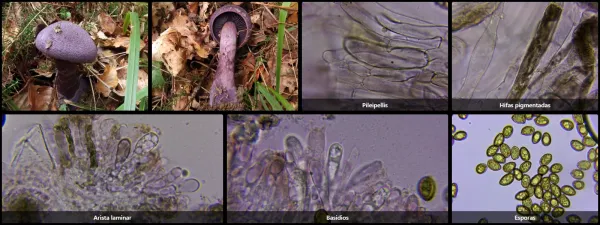

Cortinarius violaceus
Taxonomy
Main synonym
Common names
Cortinario violáceo.
Geographic references:
Interactive map with data from GBIF.
Morphological Features:
Pileus up to 15 cm in diameter, convex with an incurved margin, occasionally bearing a not very pronounced umbo. The cuticle is dry, felted or squamulose, sometimes to the point of having a velvety texture, and displays a striking dark violet color.
Lamellae adnate to slightly sinuate, rather thick and well-spaced, violet when young, later becoming ochre-ferruginous due to the spore deposit.
Stipe central and robust, solid and thickened towards the base, rather fibrillose. When young, its color is violet, like the rest of the basidiocarp, but it turns blackish with age. It bears a rather fugacious violet cortina.
Flesh violet or lilac in color, paler than the exterior of the basidiocarp, tenacious when young and somewhat spongy later, with an odor and taste reminiscent of cedar oil.
Habitat:
Fruits in summer and autumn in deciduous forests. It is a common species.
Observations:
It is one of the few Cortinarius species considered edible, although its culinary quality is not high. Authors of some publications describe it as uncommon; however, it is abundant in northern Iberia. Specimens found under conifers are referred to as ssp hercynicus (Pers.) Brand.