
Cortinarius vernus
Taxonomy
Main synonym
Common names
Cortinario primaveral.
Geographic references:
Interactive map with data from GBIF.
Morphological Features:
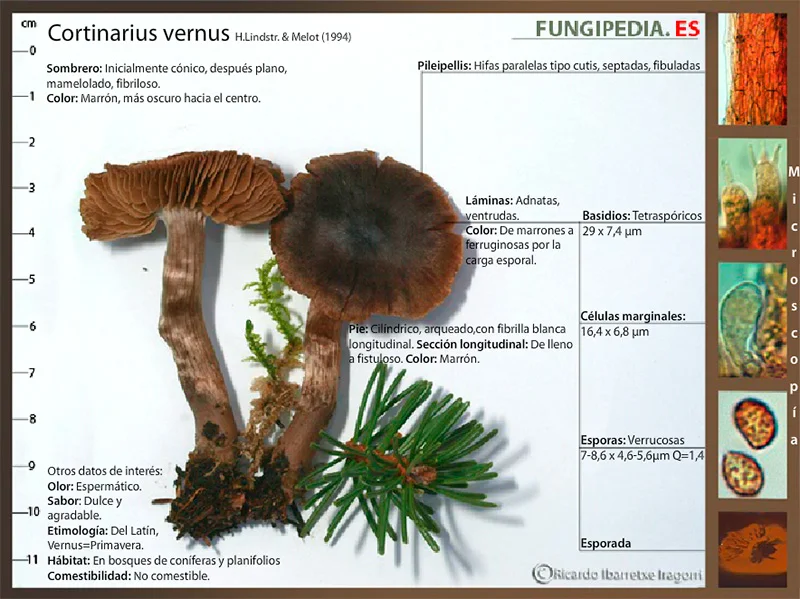
Pileus rather small for the genus, exceeding 5 cm in diameter but never reaching 10 cm, conic-campanulate when young, tending to flatten with age, but usually retaining a characteristic umbo at the center. Initially brown at the center with a somewhat grayish margin, later becoming lighter in hue but retaining a brown coloration. The surface is fibrillose, tending to develop radial cracks with age.
Lamellae adnate, brown in color, tending to stain ocre-ferruginous due to the spore print. They are ventricose and widely spaced.
Stipe elongated and central, similar in color to the pileus or slightly lighter, distinctly fibrillose. Usually curved, and generally solid.
Flesh ochraceous and firm, thin, fibrous especially in the stipe, with a spermy odor and a sweet, not unpleasant taste that contrasts with its smell.
Habitat:
As its name suggests, it is spring-fruiting, appearing associated with various trees, both spruces and broadleaf species, but invariably on moss. Uncommon, though where it occurs it often fruits in groups or even gregariously.
Observations:
An interesting species of recent taxonomic classification, which may be the first Cortinarius to emerge following the winter snowmelt with the arrival of spring. Notably, it consistently appears in mossy areas; there may be an ecological association between the mycelium of this species and moss, given that the surrounding tree species often vary—a subject warranting further study.
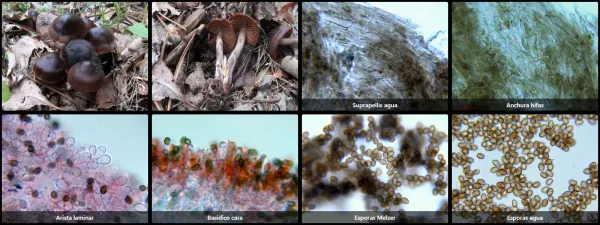
Microscopy of Cortinarius vernus