
Cortinarius tubarius
Taxonomy
Main synonym
Common names
Not available
Geographic references:
Interactive map with data from GBIF.
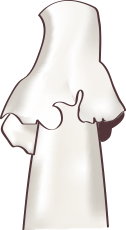
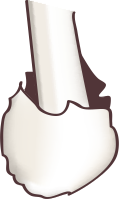
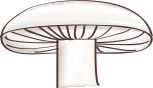
Morphological Features:
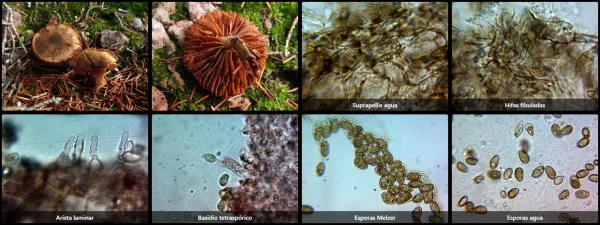
Pileus small in size, its diameter usually does not even reach 5 cm, generally ranging between 1 and 4 cm. Hemispherical at first, soon becoming convex and finally flattened, with the center prominently raised in younger specimens and paradoxically somewhat umbilicate in older ones. Its cuticle is ochraceous, darker at the center and fading toward the margin, pruinose and even fibrillose, especially when young. The margin is notably striate, sometimes appearing striate almost to the center due to translucency, as it is a hygrophanous species.
Lamellae adnate and very distant, somewhat ventricose, yellowish in younger specimens, soon staining brown with a ferruginous tinge, very regular in their arrangement.
Stipe elongated or well-proportioned, frequently incurved and cylindrical, tough, ochre in color but darkening over time from the base to brownish-black tones. It is entirely covered by whitish fibrils that may disappear due to rain, and its cortinate zone is very sparse and ephemeral.
Flesh scant and insubstantial, soft in the pileus and tough in the stipe, practically odorless and mild-tasting due to high water absorption.
Habitat:
A species that appears to be more widespread than initially believed, capable of being found in different habitats; our collection was made on the bank of a stream originating from a nearby dam, with nearby alder presence. It grew in a small group and was found in autumn; it is a rare species due to being poorly studied, as is the case with all species related to the genus Alnicola.
Observations:
The taxonomic position of this species is complex; throughout its long history it has passed through various genera, Naucoria, Tubaria, Alnicola, and now Cortinarius, though we do not know whether this placement is definitive or transitory. Its widespread character distinguishes it from alder-exclusive species such as those in Alnicola (from Alnus, alder); however, this remains its most frequent habitat and where we have found it. Differentiation of these species is only feasible after meticulous microscopic analysis, making macroscopic classification impossible; this added difficulty fosters a certain aversion toward these genera. It may be confused with any Alnicola, any Tubaria, or any Naucoria.