
Cortinarius triformis
Taxonomy
Main synonym
Common names
Not available
Geographic references:
Interactive map with data from GBIF.
Morphological Features:
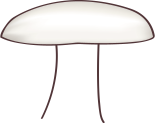
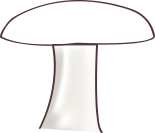
Pileus of medium size, at full maturity it can reach a diameter ranging from 4 to 8 cm, hemispherical for much of its development, eventually becoming convex to plano-convex; some specimens with the area around the center slightly raised and depressed directly at the center. Its surface is quite uniformly colored, but as it is a hygrophanous species, depending on moisture levels it may appear darker or lighter, always within ochre to brownish tones. It bears a conspicuous whitish pruina that seems to wash away with rain and reappears upon drying. Margin irregular and slightly striate.
Lamellae emarginate, ochre-grey when young and turning brown later, quite irregular in arrangement and interspersed with lamellulae; the edge is serrate, also somewhat irregularly so.
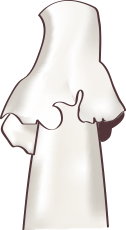
Stipe with a glossy appearance when wet but not viscid; whitish background stained with ochre tones where spores deposit on the remnants of the partial veil, longitudinally fibrillose, cylindrical or slightly enlarged at the base in some specimens, but not bulbous.
Flesh somewhat soft due to high water absorption, whitish or slightly greyish in color. Odor slightly radish-like and taste sweet.
Habitat:
This species has been recorded in highly diverse habitats; our collection was made in pine forests, with the presence of Pinus pinaster, Pinus sylvestris and a steppe-like understory (Cistus albidus). It may appear both in spring and during autumn, having been observed in both seasons. It is a relatively frequent species that grows in small groups.
Observations:
A Cortinarius belonging to the subgenus Telamonia, which encompasses species with a dry pileus, never viscid, and a Tricholoma or Collybia-like appearance. The species described here has historically encompassed several taxa now separated from it, all showing evident morphological parallels; the study of these Cortinarius species is always arduous and cumbersome, so they are poorly referenced in the literature. Some examples of similar species include Cortinarius assiduus, Cortinarius poecilopus, Cortinarius bivelus, or Cortinarius laniger.