
Cortinarius praestans
Taxonomy
Main synonym
Common names
Cortinario grande, sare bikain.
Geographic references:
Interactive map with data from GBIF.




Morphological Features:
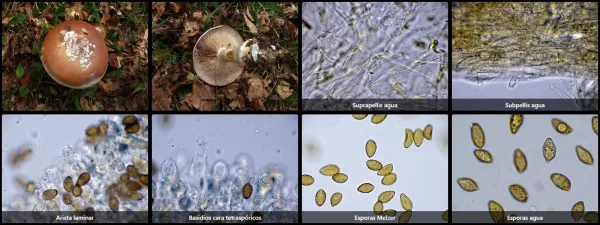
Pileus of notable dimensions, it can reach 20 cm in diameter, globose when young, then convex, never fully flattening. Fundamentally brownish, though with vinaceous or violaceous tinges, and usually adorned with whitish floccose patches, which often disappear due to rain. Somewhat viscid and shiny when wet, with an involute margin for a considerable time.
Lamellae crowded and narrow, pale lilac initially, soon turning brown. Adnate to the stipe, with a concolorous edge.
Stipe central, cylindrical, thick and solid, bulbous at the base and narrower at the junction with the pileus. It bears conspicuous remnants of a cortina in the upper region, which is whitish with lilac tinges. The stipe itself is also whitish, with the upper portion slightly lilac.
Flesh thick and firm, pale in the pileus and lilac in the stipe. Its raw taste is slightly bitter, and its odor is mild and pleasant.
Habitat:
This cortinarius fruits primarily in autumn, occurring in broadleaf forests, particularly beechwoods, with a marked preference for calcareous soils. It is an uncommon species.
Observations:
It is regarded as the most culinarily valuable species in its genus; its slight bitterness disappears upon cooking. The mushroom's large, fleshy structure provides a good yield, and although its flavor is mild, it remains palatable. It may resemble other Cortinarius species within its group, such as Cortinarius variicolor, which possesses a pronounced odor.