
Cortinarius olens
Taxonomy
Main synonym
Common names
Cortinario aromático
Geographic references:
Interactive map with data from GBIF.
Morphological Features:
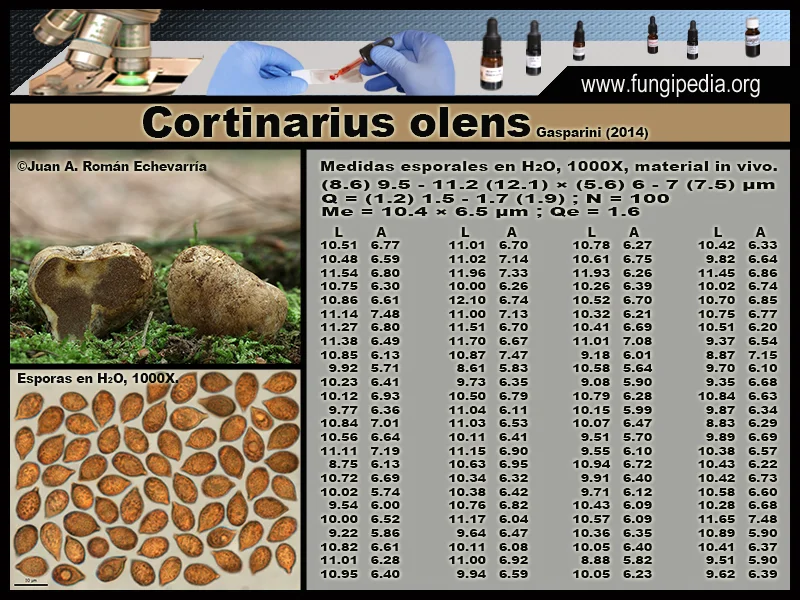
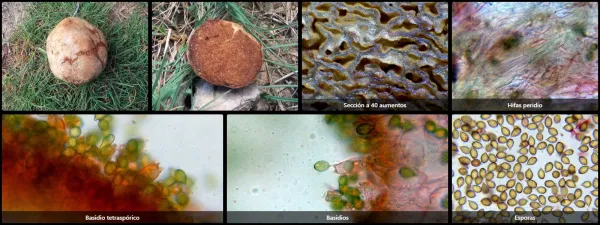
Basidiocarp with the typical tuber-like or potato-shaped form characteristic of hypogeous or semi-hypogeous fungi, as is the case here; it can be practically globose, subglobose, or somewhat more oblong and compressed, lacking excessive protuberances, sometimes reniform or, as shown in our photographs, slightly turbinate. Its size is moderate; in mature specimens, the diameter generally ranges between 3 and 6 cm. The color is quite variable depending on the maturity stage of the specimen, initially whitish with a silvery or lilac tinge, later turning to more ochre tones. The overall appearance of the basidiocarp is somewhat glossy but dry, with a rather soft consistency.
Peridium quite thin, initially silvery-white, acquiring ochraceous tones over time, but remaining whitish when cut. Smooth and glossy but not viscid, glabrous, and composed of a filamentous hyphal structure.
Gleba labyrinthine, composed of irregular chambers that are generally quite small or closed, expanding slightly at maturity. The chamber size is generally highly variable, rounded or flattened, beige in the early developmental stages of the specimens, later turning a strong ochre tone with some pinkish or reddish tinge. It has a rather elastic consistency, and unlike most hypogeous species or genera, it lacks sterile veins and also lacks a columella. It bears papillate spores of very small size compared to species of the genus Hymenogaster, in which it was formerly placed; their shape is strongly reminiscent of apple seeds. Both bispored and tetraspored basidia are present (see microscopic features).
Flesh which is essentially the gleba itself, elastic and not firm, with a characteristic fruity odor that is not unpleasant in young specimens but becomes overly intense upon maturation.
Habitat:
This is a species that fruits hypogeously, although near the surface, occasionally emerging with maturation. It is more readily located thanks to forest animals that often unearth them, as well as by trained dogs. It typically appears during spring months; we have not collected any specimens outside this period, and it shows a particular preference for mountain pine forests. Located in the Sierra de Cameros (La Rioja), in May, under Pinus sylvestris, at an altitude between 1000 and 1500 m.a.s.l. It is never found gregarious; always solitary or in pairs at most.
Observations:
Species characterized by its whitish color when young, its tightly packed labyrinthine gleba lacking sterile veins, and by its characteristic fruity odor. It may seem somewhat unusual to assign a hypogeous species to the genus Cortinarius, but both its microscopic features and relevant molecular analyses attest to this placement. It was formerly placed within the genera Hymenogaster and Protoglossum, with which it shares evident similarities, particularly morphological ones; however, these genera generally comprise species with much larger spores. Protoglossum niveum is a very similar species with which it may be confused; it is smaller in size and possesses spores that are practically twice as large.
Microscopy of Cortinarius olens