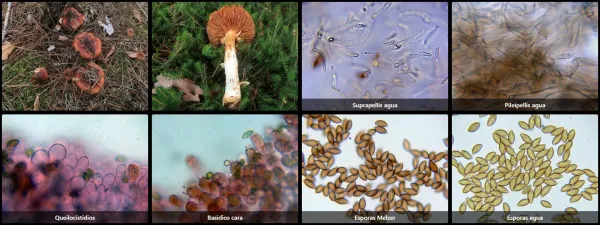

Cortinarius mucosus
Taxonomy
Main synonym
Common names
Cortinario viscoso.
Geographic references:
Interactive map with data from GBIF.


Morphological Features:
Pileus reaching over 10 cm in diameter, most commonly found between 5 and 10 cm; bell-shaped in its initial developmental stage, subsequently convex, and finally flattened. Dark in the central zone, reddish-brown, gradually lightening towards the margin, with mahogany tones transitioning to orange or yellowish hues near the edge. Surface highly viscid, mucilaginous in rainy weather; even during dry periods, it adheres to a moist finger upon contact. Margin strongly incurved for much of its development.
Lamellae adnate and relatively crowded, whitish or cream-colored when young, becoming ochraceous, and even cinnamon-brown after spore maturation.
Stipe rather elongated, smooth in the upper portion up to a mucilaginous, ring-like cortina; below this it is highly viscid and floccose. Solid, white, and cylindrical in shape, though frequently attenuated at the base.
Flesh relatively thick and white, with a sweet but not particularly pleasant taste and an insignificant odor.
Habitat:
A frequent species that fruits during the autumn months, consistently associated with conifers and showing a marked preference for acidic soils.
Observations:
This group of viscid Cortinarius species is highly peculiar, belonging to the subgenus Myxacium, which comprises species with viscid pilei and stipes, and non-lilac lamellae. This species is characterized by its attenuated white stipe and orange-brown pileus, resembling Cortinarius collinitus, which is somewhat smaller and has a different ecology. It also resembles Cortinarius mucifluus, which is more robust and possesses significantly less cortina.