
Phlegmacium inexspectatum
Taxonomy
Main synonym
Common names
Not available
Geographic references:
Interactive map with data from GBIF.


Morphological Features:
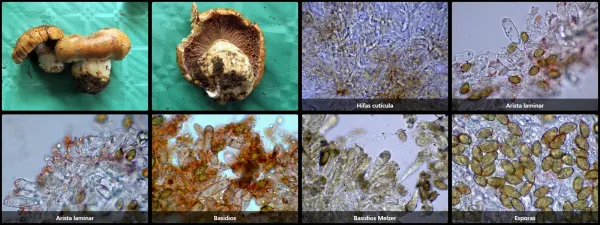
Pileus of robust stature and fleshy appearance, reaching over 10 cm in diameter in mature specimens. Hemispherical in the early developmental stage, becoming convex and finally plano-convex, never fully flattening. The surface is reddish-brown, except perhaps at the margin which is paler and ochraceous; it is notably viscid, especially after rain, and radially fibrillose. The margin is involute in young specimens, becoming regular in adults, slightly incurved if anything, but scarcely to not at all undulate.
Lamellae adnate to slightly sinuate, pale at first, turning ochraceous with maturity and brown in the final developmental stage. They are narrow and fairly crowded, with an irregular, somewhat heterogeneous spatial arrangement, and feature an irregular, concolorous edge.
Stipe, like the pileus, robust and fleshy in appearance, cylindrical or clavate, with a very thick, marginated bulb at the base, up to 5 cm in diameter. The background color is whitish, but covered with randomly arranged fibrils and remnants of the veil that are brownish or rust-colored. An abundant and persistent white cortina forms a cortinate zone at the upper third, typically stained by deposited spores.
Flesh compact and thick, very firm, white and unchanging on exposure. The odor is mild, and the taste is sweet.
Habitat:
This is an exclusively spring-fruiting species that grows under mountain conifers, always on soils with a basic pH. It is a highly localized mushroom but faithful to its fruiting sites, warranting classification as rare. The photographed specimens are found annually between April and May in the Sierra de Cameros, La Rioja, under Pinus silvestris at an approximate altitude of 1300 m asl.
Observations:
Once its existence is known—which is the most difficult part—identification is not particularly problematic, as it is the only Cortinarius of section multiformes that fruits in spring. There are many autumnal congeners that bear a resemblance to this species; among them, we highlight Cortinarius napus, which fruits on acidic soils, and Cortinarius cedretorum, which has rather greenish lamellae.