Calonarius cupreorufus
Taxonomy
Main synonym
Common names
Not available
Geographic references:
Interactive map with data from GBIF.




Morphological Features:
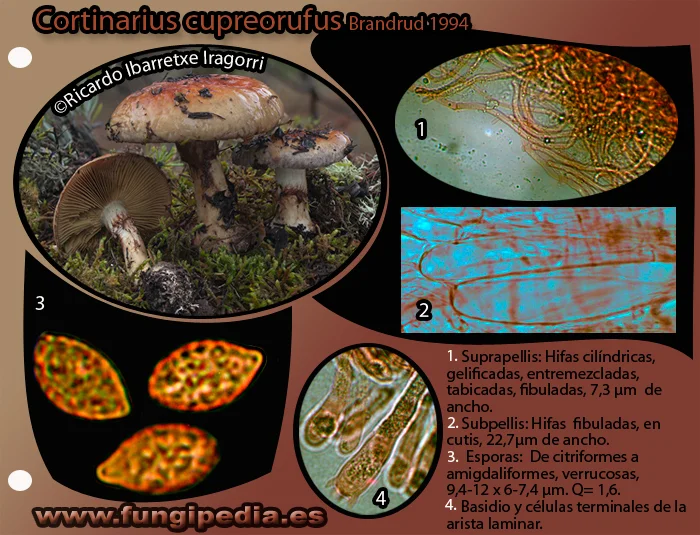
Pileus with a fleshy and robust appearance; the diameter of the largest adult specimen located was 11 cm, while the rest ranged between 5 and 10 cm, not ruling out the possibility that specimens may attain somewhat larger dimensions. Hemispherical at first, soon becoming convex to plano-convex; it may flatten considerably but usually retains a slightly raised center. The cuticle is separable, viscid, and lustrous, especially under high humidity conditions, with a striking vermilion-red center that fades to more coppery tones, whereas the margin is olive-grey. This margin is not striate, and the edge is quite regular.
Lamellae adnate and rather crowded, yellowish when young, later developing marked olive tones, and finally stained by the spore deposit with ochre-ferruginous hues.
Stipe initially short and robust, solid; becomes much more slender with age but retains a sturdy bearing. Yellowish or olive in color. Adorned with remnants of a pale yellow partial veil that stains with the spore color. Cylindrical except at the base, where it bears a well-defined marginated bulb, especially in younger specimens. Not viscid.
Flesh firm throughout, light-colored, sometimes whitish but generally with a more olive hue. Unchanging on exposure except at the base, where it stains vinous-red. Odor fungal and mild; taste sweet but not particularly pleasant.
Habitat:
A species documented under various conifers on predominantly calcareous soil; we observe it annually in pine woodlands with several different pine species and a steppe-like understory (Cistus albidus). It typically fruits in groups, rarely isolated; however, it should be considered rare due to its highly localized and limited distribution. It has been found during autumn; we have not observed it at other times of the year.
Observations:
This is a conspicuous species included in the subgenus Phlegmacium, within the marginate-bulbous group, and due to the olive tone of its lamellae, it falls within section Virentophylli. It is characterized by a striking red pileus center and a stipe base that stains vinous-red on exposure. Cortinarius odorifer resembles it closely, but its distinctly anise-like odor distinguishes it; Cortinarius rufoolivaceus is also very similar, differing by its bitter taste and the lilac coloration of the upper stipe region.
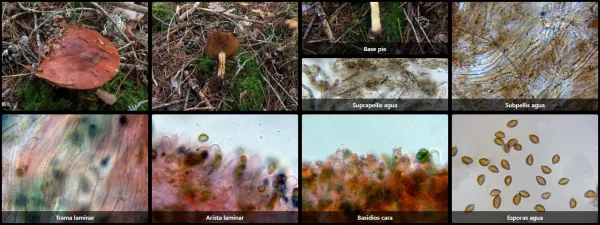
Microscopy of Calonarius cupreorufus