
Cordyceps militaris
Taxonomy
Main synonym
Common names
Beldar-mazo.
Geographic references:
Interactive map with data from GBIF.

Morphological Features:
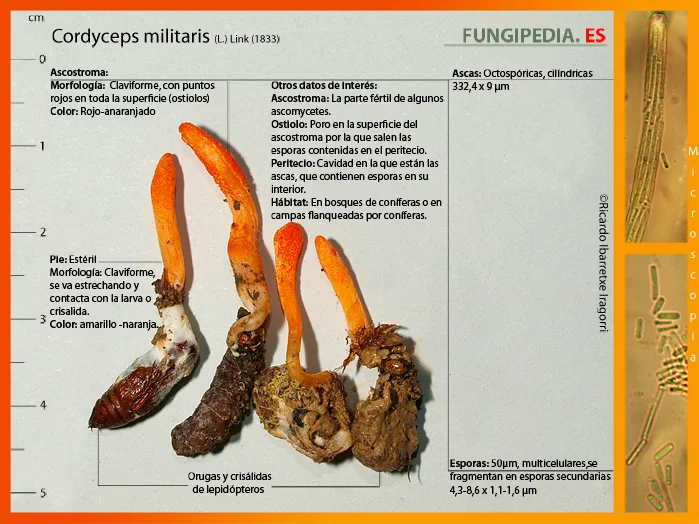
Carpophore slender and stipitate, up to 5 cm in height and 2 to 5 mm in width. In young specimens, the stipe and head are hardly distinguishable, but gradually become defined. The upper portion or head is bright orange and bears prominent granulations, which are nothing other than perithecia, giving the carpophore a rough appearance dotted by ostioles. This head is usually club-shaped, or more typically flattened.
Hymenium situated on the surface of the upper region or head, orange-colored, smooth or dotted at maturity.
Stipe pale orange to yellowish, dotted or scurfy.
Flesh insignificant due to the small size of the fungus, with no appreciable odor or taste.
Habitat:
This is a parasitic species of various Lepidoptera; within our study area, it is commonly found parasitizing pupae of the pine processionary moth (Thaumetopoea pytiocampa). It occurs especially in late autumn on mossy, humid slopes.
Observations:
When processionary caterpillars burrow to form pupae from which brightly colored moths will emerge in summer, some carry spores of this fungus. Under suitable environmental conditions, the fungus fruits, enveloping the pupa with its mycelium (see photo) and ultimately killing it; from that pupa no moth will emerge, but rather the fruiting body of Cordyceps militaris. Another parasitic fungus of Lepidoptera is Cordyceps gracilis, distinguishable from the present species by its paler colors and prominent head, which recalls Elaphocordyceps capitata.
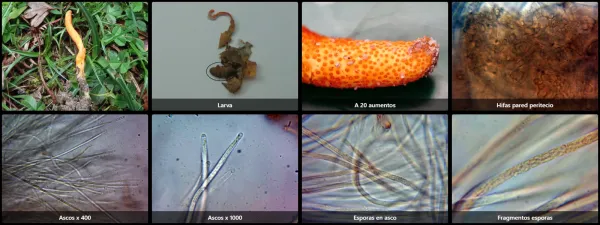
Microscopy of Cordyceps militaris