
Coprinopsis erythrocephala
Taxonomy
Main synonym
Common names
Coprino rojo.
Geographic references:
Interactive map with data from GBIF.


Morphological Features:
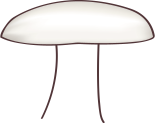
Pileus reaching a maximum diameter not exceeding 2 to 3 cm at full maturity; initially ovoid and attached to the stipe at the base, it gradually expands to become first campanulate, then flattened, and eventually with uplifted margins in older specimens. The background color is grayish, but it is entirely covered by erect scales of a striking vermilion red, giving it a truly beautiful appearance. These scales are more prominent in young specimens and tend to disappear over time and with rain; older specimens become smooth and deeply striate, grayish with some ochraceous tinges.
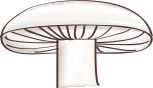
Lamellae free, whitish with reddish tinges initially; they darken over time until becoming black due to deliquescence. They are ascending, and the edges are typically smudged with dark grayish-black tones from a very young age.
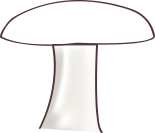
Stipe elongated, longer than the pileus diameter in mature specimens; cylindrical but slightly narrower at the apex. White in color, but covered with red floccose scales; this red color predominates in young specimens, and these scales are usually denser in the lower region.
Flesh thin and unremarkable, with no odor or flavor worthy of mention.
Habitat:
Existing references for this species do not indicate that it is eminently coprophilous; however, our collection was made on cattle dung in a forest of Picea abies and Pseudotsuga menziesii. Located in spring 2014 in Guillerna (Álava), with several specimens emerging individually from a single dung pat. It is a rare species that should be protected.
Observations:
We are dealing with a species as beautiful as it is poorly documented; this collection was, in fact, the first record for the Basque Country. It is characterized by the beautiful vermilion or saffron red color of the entire basidiome, which is particularly striking in young specimens, as this covering is gradually lost over time. The peculiar characteristics of this species and its color, exceptional for its genus, make it practically unmistakable.