

Narcissea ephemeroides
Taxonomy
Main synonym
Common names
Coprino efímero.
Geographic references:
Interactive map with data from GBIF.




Morphological Features:
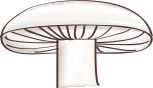
Pileus very small; an extraordinarily large specimen might reach 1 cm in diameter, but they are typically found measuring between 4 and 8 mm when fully developed. Upon emergence, the pileus is ovoid, then becomes campanulate, eventually flattening out and sometimes with the margins turning upward. This entire morphological transition may take merely a couple of hours. The surface is whitish or slightly ochraceous at the center, translucent elsewhere, and appears entirely striate due to transparency.
Lamellae translucent, resembling folds, turning black due to deliquescence; distant.
Stipe elongated and very slender, typically 2 to 4 cm long by merely a couple of millimeters thick, whitish or translucent, with a small bulb at the base. Many specimens of this species possess a sliding and very fragile ring roughly midway up the stipe, but it sometimes disappears due to rain.
Flesh practically nonexistent, with no significant odor or taste discernible.
Habitat:
It is an exclusively coprophilous species, fruiting on livestock dung of various kinds; we have observed it on horse and cattle dung. Its fruiting season is spring, though it may also appear during autumn. It is relatively common but, being so small and ephemeral, often goes unnoticed.
Observations:
It is a fungus that is difficult to observe; its lifespan is reduced to just a few hours, which gives it its name, and it is also very small and fragile. The presence of a movable, sliding ring on the stipe distinguishes it from other coprophilous Coprinus species such as Coprinellus curtus. There are also other non-coprophilous species that resemble it, making a detailed microscopic study essential for accurate identification.