
Coprinellus micaceus
Taxonomy
Main synonym
Common names
Coprino micado, urbeltz mikadun, bolet de fermer (micaci).
Geographic references:
Interactive map with data from GBIF.


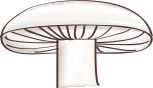
Morphological Features:
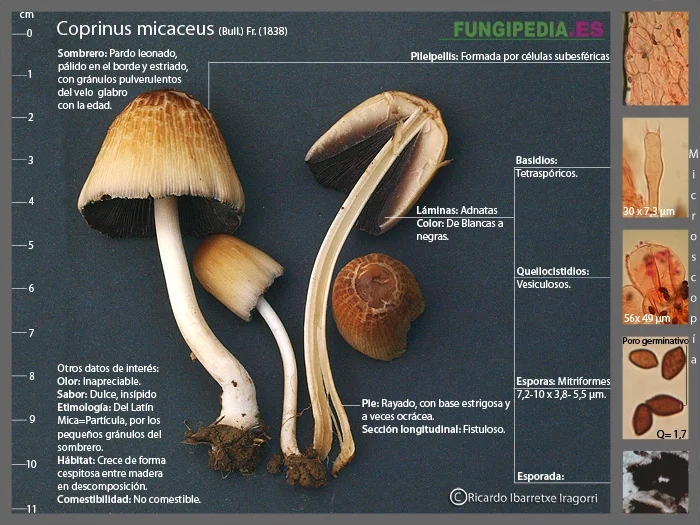
Pileus with a diameter that never exceeds 5 cm; initially ovoid, later becoming campanulate, a shape it retains until its degradation phase, never flattening out. The surface is ochre-colored, sometimes with yellowish tints, varying in shade among specimens, with the center being darker and fading towards the margin. The entire surface is striate and radially grooved, almost throughout, and bears, especially in young specimens, whitish flakes or granules that are spherical and crystalline under the microscope, reminiscent of mica—a distinguishing feature that gives the species its name. These flakes wash away with rain.
Lamellae adnate to free, ascending, white in the initial growth phase, later turning gray and finally blackish. They are typically rather crowded and narrow, and are not particularly deliquescent when compared to those of related species.
Stipe central and cylindrical, whitish or concolorous in older specimens, finely silky or smooth, sometimes slightly thickened at the base where it attaches to the substrate.
Flesh scant and soft, white in color; odor barely perceptible, taste mild and insipid.
Habitat:
On stumps or woody debris of broadleaf trees, sometimes apparently on the ground, forming groups of numerous individuals with a caespitose growth habit. Except during the harshest part of winter, it can be found year-round, being a frequent and abundant species.
Observations:
This species is characterized by its striate and grooved pileus, its micaceous covering, and its caespitose or fasciculate growth on wood, sometimes buried. Many similar Coprinus species exist, such as Coprinellus domesticus, which differs from it by the structure of the pileipellis with elongated hyphae; Coprinellus radians, which grows individually; or Coprinellus silvaticus, which has spores with verrucae visible under the microscope, among others. Microscopic analysis is required for the accurate determination of species within this genus.
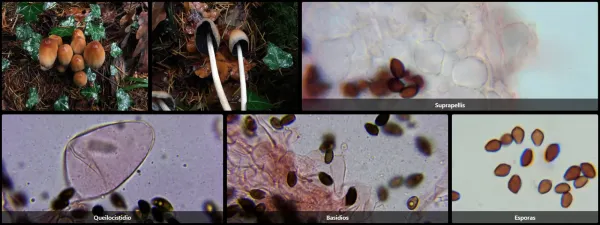
Microscopy of Coprinellus micaceus