
Pholiotina teneroides
Taxonomy
Main synonym
Common names
Not available
Geographic references:
Interactive map with data from GBIF.

Morphological Features:
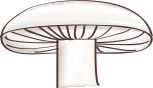
Pileus with a diameter that can range in mature individuals between 1 and 3.5 (4) cm; through its successive growth stages it changes from ovoid to hemispherical, then convex, and finally convex-flattened, without becoming completely flat, subtly raised or umbo-nate at maturity. Cuticle dry and matte in appearance, only slightly glossy when wet, floccose in young specimens, of variable color within ochre tones; depending on hydration it may be honey-colored, more distinctly ochre especially in the center, and even yellowish near the margin. Striate due to gill transparency at the margin, sometimes extending up to half the radius.
Lamellae adnate and more or less ventricose; initially pale, then yellowish-clay colored, later honey-colored, and finally darker towards maturity, without reaching the cinnamon tones of other related species. Gill edge much paler, whitish, floccose and irregularly serrate or crenulate.
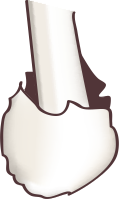
Stipe elongated and cylindrical; initially pale, then ochraceous, darkening from the base with brownish tones, while the apex is usually the lightest area. Bears a persistent, movable ring resembling a skirt, whitish in color, often smeared with spore deposit, striate above and smooth below. Surface longitudinally striate and floccose, more pronounced below the ring, pruinose at the apex.
Flesh scant and somewhat soft, same color as the pileus, slightly more fibrous in the stipe; odor mild and slightly acidulous, taste analogous, not bitter.
Habitat:
A species for which different habitats are specified based on alleged synonymies that are not valid; our collections were made under Pinus sylvestris, on soil with basic pH, in the presence of livestock, thus in a nitrogen-enriched area, sometimes directly on the ground and other times bordering the manure itself. We have found it at several locations within the same pine forest, usually in small groups, rarely solitary, in late November.
Observations:
There is some confusion regarding these ringed species of the genus Conocybe; many authors erroneously establish synonymies with Conocybe blattaria, given that the species presented here possesses bisporic basidia and clavate cheilocystidia, whereas Conocybe blattaria exhibits tetrasporic basidia and ampulliform cheilocystidia. Macroscopic differences also exist (e.g., ring type). Conocybe percincta is very similar, to the point that some consider them synonymous; they are only separated by subtle differences: it has more yellowish tones and slightly smaller spores. Here, we have considered it synonymous, prioritizing Conocybe teneroides based on taxonomic priority.
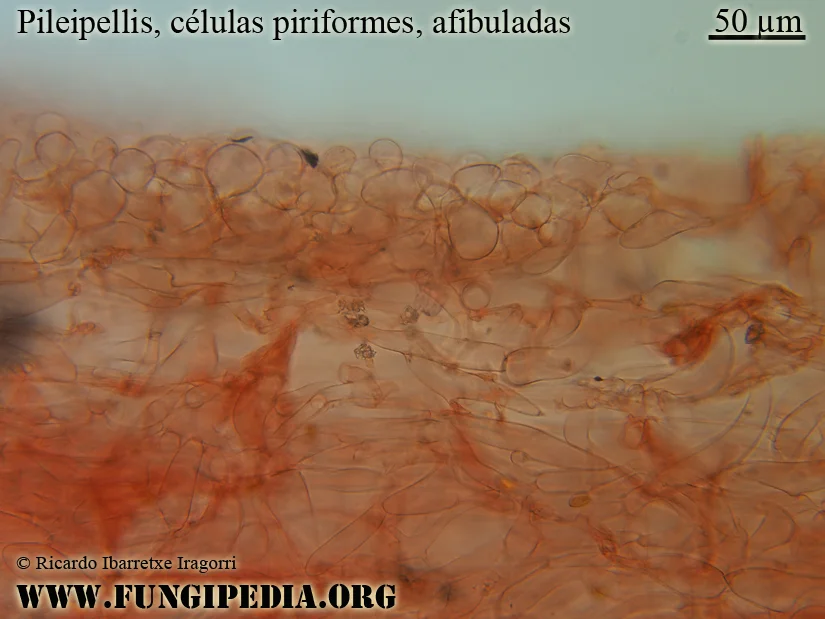
Microscopy of Pholiotina teneroides