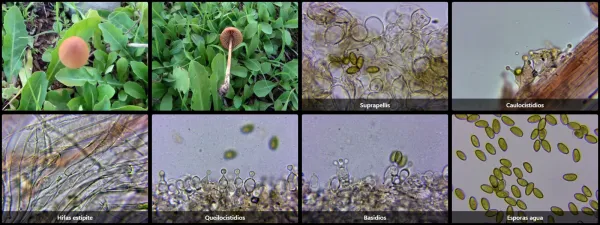
Conocybe tenera
Taxonomy
Main synonym
Common names
Conocibe delicado, konozibe samur.
Geographic references:
Interactive map with data from GBIF.




Morphological Features:
Pileus very small; a specimen measuring 3 cm would be considered large for this species. Conical in its early stage, it becomes campanulate, without evolving into any other form. Its base color is ochre, becoming paler or darker depending on the specimen's hydration. It is hygrophanous and additionally translucently striate.
Lamellae adnate and relatively crowded, cream-colored at emergence, quickly turning to cinnamon tones, and darkening to reddish-brown shades in age.
Stipe very long relative to the pileus diameter, pruinose and concolorous or slightly paler; it may exhibit a somewhat inconspicuous bulb-like swelling at the base and is longitudinally striate, although this feature is sometimes not visible to the naked eye.
Flesh fragile and very scanty, ochrace in color, with no notable odor or taste.
Habitat:
Fruits in both spring and autumn among the grass of parks and gardens, typically in enriched soils, but not directly on dung; it is terrestrial. It is the Conocybe species most frequently illustrated in literature, though this does not make it the most common.
Observations:
The group in question comprises a relatively broad array of similar, difficult-to-differentiate taxa, with the species described here being the best known. There exists a species, Conocybe semiglobata, with somewhat larger spores and, based on our experience, more common. Conocybe rickenii is also very similar, typically fruiting directly on dung, as do many other Conocybe species. Microscopic examination is essential for the accurate identification of these species.