

Conocybe ovalis
Taxonomy
Main synonym
Common names
Not available
Geographic references:
Interactive map with data from GBIF.
Morphological Features:
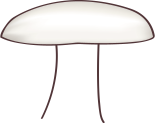
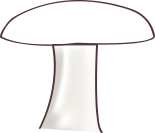
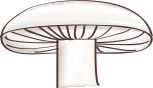
Pileus that at its maximum development can reach 3 to 3.5 cm in diameter, which curiously is a by no means negligible measurement for the genus in question. Initially bell-shaped, it later expands somewhat to become conico-convex, without flattening out. When the specimen is hydrated, the margin is striate, and its color is ochraceous, more or less dark depending on the hydration level of the mushroom.
Lamellae adnate, ochraceous-leonine when young, turning darker ochraceous with age.
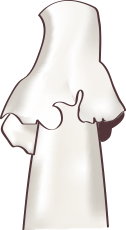
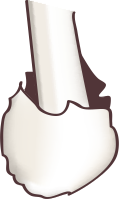
Stipe relatively long in proportion to the pileus, slender and lighter in color, longitudinally grooved, and terminating at its base in a marginate bulb that may go unnoticed if the mushroom is pulled out without due care.
Flesh ochraceous, scant and of low consistency, without special odor or defined taste.
Habitat:
Occurs during rainy springs as well as in summer and autumn, in moist and nitrogen-rich habitats, sometimes directly on dung.
Observations:
It is one of the Conocybe species within the Conocybe tenera group, which presents taxonomic difficulties. The most relevant macroscopic characteristic is the marginate bulb at the base of the stipe. It is also very similar to Conocybe rickenii, from which it differs only microscopically, and whose bulb is simple rather than marginate. We consider that this species is currently effectively delisted from modern catalogs, although we have followed Bruno Cetto's criteria for its classification.