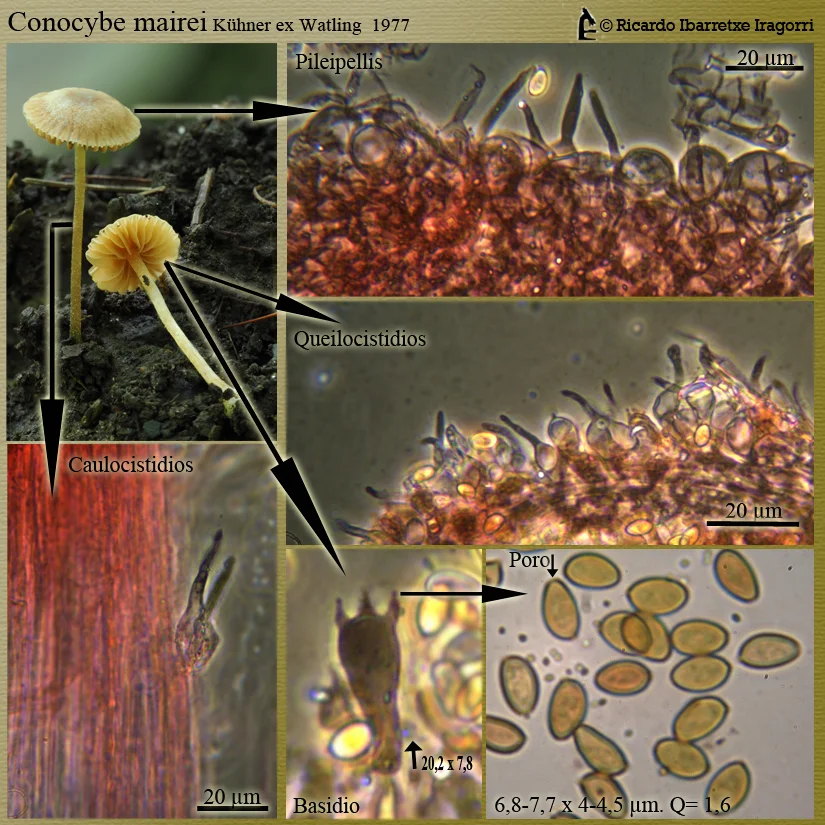
Conocybe mairei
Taxonomy
Main synonym
Common names
Not available
Geographic references:
Interactive map with data from GBIF.




Morphological Features:
Pileus small in size; according to the literature, its diameter ranges from 5 to 10 mm at maturity. The specimens from our collection measured approximately 6 mm. Initially convex, it gradually flattens but retains a slightly raised center. Cuticle dry and matte in appearance, variable in color, even exhibiting different shades across zones of the same specimen due to its hygrophanous nature; cream or pale ochre, generally with yellowish tinges. Margin striate-translucent for approximately two-thirds of its length when moist, with the striated area diminishing as it dries.
Lamellae adnate and ventricose, rather distant from each other, initially yellowish-cream in color, becoming stained with spore deposition to ferruginous-ochre or cinnamon.
Stipe central and cylindrical, notably elongated relative to the pileus diameter, similar in color to the cap, also with yellowish tinges especially in young specimens, over 0.5 mm thick, rather pruinose but lacking a ring or annular zone, with a thickened, whitish, cottony base.
Flesh scant and insignificant, with no notable odor or taste observed.
Habitat:
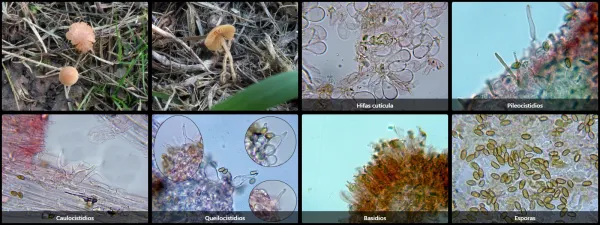
A species poorly referenced in the literature and therefore considered rare or infrequent. The collection serving as the basis for this record was made in July 2016 on sandy soil beneath alders (Alnus glutinosa). We understand that it may appear in other habitats and at different times of the year if conditions are favorable; a small group of specimens was found.
Observations:
A species belonging to a fairly homogeneous group of small-sized Conocybe taxa, all sharing common macroscopic characteristics, making species-level classification impossible without thorough microscopic study. For example, it closely resembles Conocybe aberrans or Conocybe parvula; their differences are strictly microscopic and pertain to spore length or pileocystidia size. We classify it as having no culinary value due to this aspect being poorly studied, although the presence of toxins in these species is quite plausible.
Microscopy of Conocybe mairei