
Conocybe filaris
Taxonomy
Main synonym
Common names
Not available
Geographic references:
Interactive map with data from GBIF.
Morphological Features:
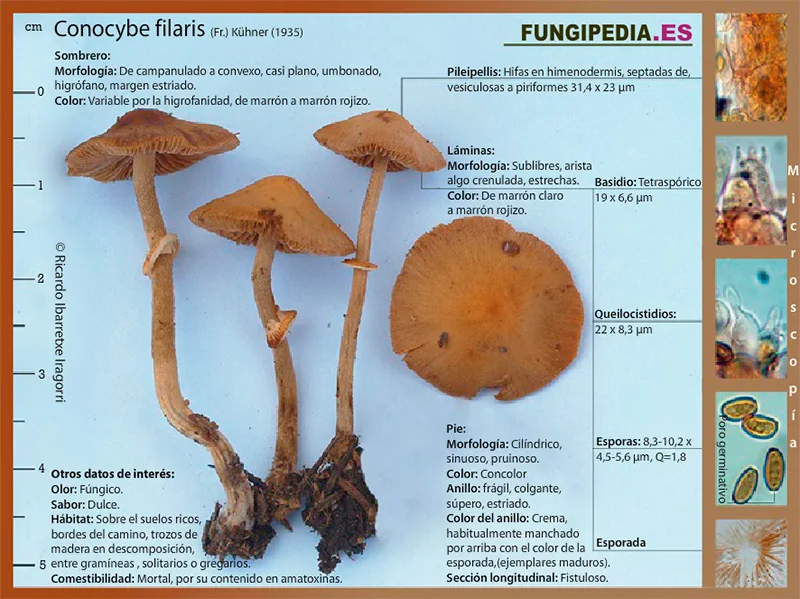
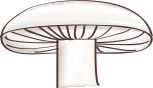
Pileus of small dimensions, not reaching 3 cm in diameter, bell-shaped in its initial stage, later becoming convex, and finally plano-convex. Throughout its development, it retains a rather broad, obtuse umbo at the center. The color varies depending on the specimen's hydration level, ranging from reddish-ochre to a light brown, almost straw-like hue. Its hygrophanous nature causes it to appear radially striate by transparency.
Lamellae adnate or free from the stipe, light brown when young, later becoming darker or reddish-brown, relatively crowded with interspersed lamellulae. The lamellar margins are crenulate.
Stipe cylindrical and sinuous, generally longer than the pileus diameter, of a similar color. Entirely covered with a pruinose coating. Bears a ring, sometimes low and fragile, cream-colored and skirt-like, which is typically stained on its upper surface by spore deposit.
Flesh scant and soft, light ochre in color, with a mild fungal odor and a sweet taste.
Habitat:
Found in late summer, though it also fruits during autumn. A rare, uncommon species that fruits on soils rich in humus and nitrogen, but is not coprophilous.
Observations:
Its high concentration of amatoxins, similar to that of small Lepiota species, makes it deadly poisonous. The incubation period for amatoxins, which cause cyclopeptide syndrome, exceeds 6 hours, meaning liver damage can be irreversible. Regarding look-alikes, it closely resembles Conocybe aporos, which is much more common than the species described here.
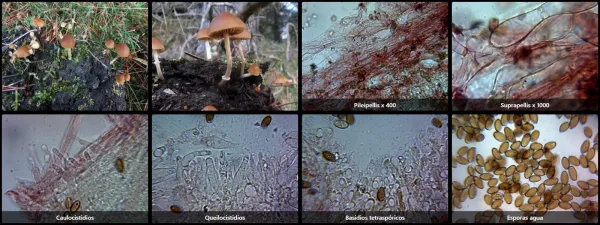
Microscopy of Conocybe filaris