
Conocybe brunnea
Taxonomy
Main synonym
Common names
Not available
Geographic references:
Interactive map with data from GBIF.
Morphological Features:
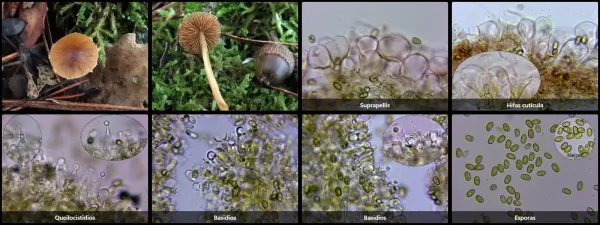
Pileus of medium size for the genus; adult specimens typically measure between 2 and 3 cm in diameter, occasionally somewhat larger. Initially hemispherical, soon convex, and finally nearly plane with a raised central zone. Cuticle somewhat rugulose, ochraceous with color variations depending on maturity or desiccation, often darker centrally. Glossy when wet, dry and matte otherwise. Margin may bear appendiculate veil remnants in young specimens that fade with age; radially striate by transparency when young, but lacking striae in drier specimens.
Lamellae adnate to slightly sinuate, pale ochraceous to ferruginous-ochre, subdistant and somewhat ventricose, with an irregular, concolorous edge that may occasionally exhibit a whitish, scaly appearance.
Stipe cylindrical and typically elongate relative to the pileus, pruinose especially at the apex, entirely fibrillose, and may exhibit faint longitudinal striations. Color is highly variable; it has a pale background that gradually darkens from the base upward with reddish-brown tones, while the apex usually remains somewhat paler than the rest. Hollow (fistulose) and lacking an annulus.
Flesh thin, pale ochre in color; odor weak and faintly perceptible, taste analogous, sweet and mild.
Habitat:
A saprotrophic species that may occur on soil, forest humus, various woody debris, or directly on the wood of various trees. It typically fruits during autumn months; our collection was made in late autumn along a path bordering a Pinus sylvestris stand with basic soil, apparently growing on soil. This species should be considered rare or infrequent.
Observations:
A small species characterized by its hygrophanous pileus, which exhibits striae or not depending on humidity, appendiculate veil remnants on the pileal margin of young specimens, and a stipe that darkens from the base upward. Microscopic examination is required to confirm the species within the genus Conocybe, as it bears notable resemblance to its congeners, particularly those also possessing appendiculate veil remnants such as Conocybe vestita. It may also be confused with the deadly poisonous Galerina marginata, which is more strictly lignicolous and possesses a distinct annulus, a feature lacking in the species described here.
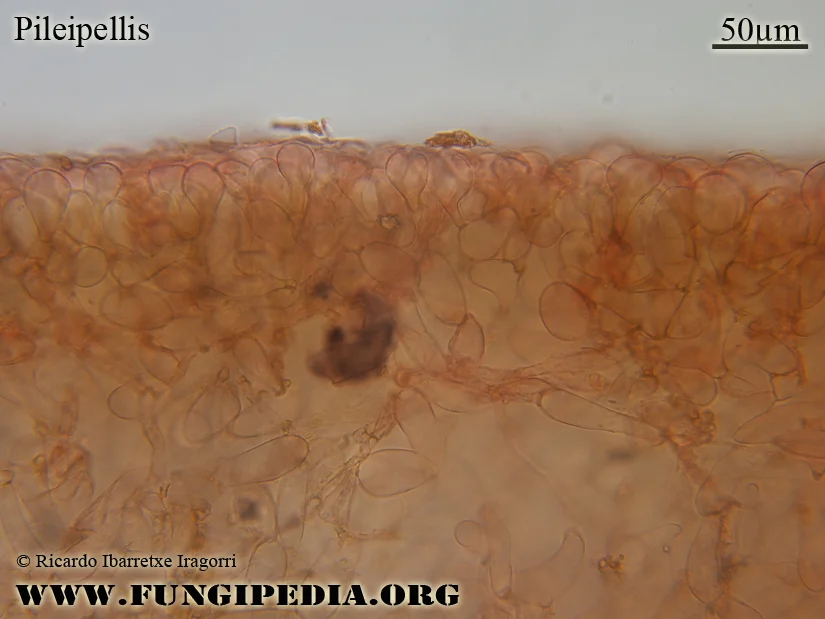
Microscopy of Conocybe brunnea