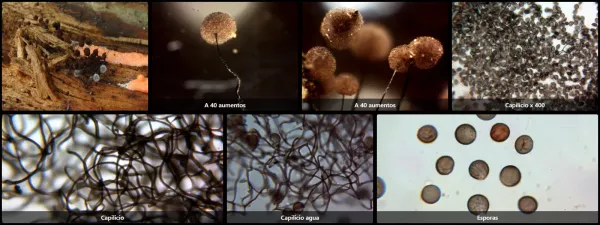
Comatricha nigra
Taxonomy
Main synonym
Common names
Not available
Geographic references:
Interactive map with data from GBIF.





Morphological Features:
Plasmodium white in color, translucent and even transparent, which, as is characteristic of Stemonitomycetidae, is of the aphanoplasmoid type. The main characteristics distinguishing this type of plasmodium are, on one hand, the homogeneity of the veins composing it, with no distinction between gelatinized and more fluid zones among them, and on the other hand, its composition of fine, transparent filaments that interconnect to form a somewhat irregular network. From the plasmodium, a mucilaginous substance known as the hypothallus forms, concentrating into spherical masses from which the reproductive bodies of the species will emerge individually, thereby concluding its somatic phase and initiating its reproductive phase at that point.
Sporocarps emerging as multiple individual fruiting bodies, each composed of a stalk occupying two-thirds of the total height and a spherical head. The former emerges and rises from the hypothallus, composed of black fibers. Upon completion of this stalk growth phase, the fertile head forms, which will house the capillitium and spores. Initially white, this head subsequently develops, becoming shiny and reddish, then turning black, and finally ruptures to release the capillitium. The capillitium is attached to the columella, which extends nearly to the apex of the sporocarp, and consists of intertwined fibers that may form loop-like structures. The entire structure measures only a few millimeters in height. The spores are lilac-ochre in color, verrucose, and possess a germ pore, measuring approximately 7 to 10 micrometers.
Habitat:
Grows on decaying wood of various trees; rarely found isolated, it typically emerges as a more or less numerous group from the same plasmodium. It is a species very difficult to locate due to its small size, and it is also quite uncommon; we have observed it during the winter months.
Observations:
This is a Myxomycete classified among the endosporous taxa, i.e., with spores developing inside a sporocarp, which together with the genus Stemonitis constitutes the two main groups of the family Stemonitidaceae. The entire reproductive phase, up to dehiscence and exposure of the capillitium, is a complex developmental process that unfolds in merely a few hours. It may be confused with Trichia species, which possess a much more abundant capillitium that detaches easily, aside from other microscopic characteristics.