
Collybia tuberosa
Taxonomy
Main synonym
Common names
Not available
Geographic references:
Interactive map with data from GBIF.
Morphological Features:
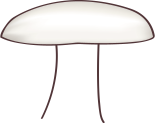
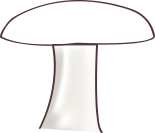
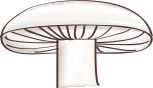
Pileus very small, not exceeding 1 cm in diameter, normally around 0.5 cm in diameter, initially campanulate but quickly becoming convex, and finally flattened. It is of a fairly saturated white color, and its surface only becomes glossy when wet; it is typically seen dry and silky. An important detail is that its margin is not grooved, thus lacking striae, and it is furthermore thin and quite regular. Of a thin and fragile appearance.
Lamellae adnate to the stipe, whitish and somewhat duller than the pileus, even tending to become creamy. It possesses quite numerous lamellae for such a small basidiocarp, crowded.
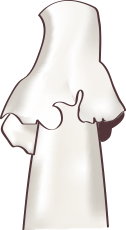
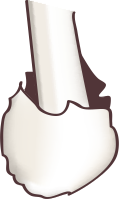
Stipe disproportionately elongated relative to the pileus, initially whitish but tending to stain flesh-colored. Fibrillose and silky, arising from a sclerotium that is reddish-brown to black externally and white internally; the size of this sclerotium also typically measures around 0.5 cm.
Flesh thin, insignificant, without distinctive odor or taste.
Habitat:
This small basidiocarp develops on decaying plant debris, as well as on old, rotting Russulas. It is typically found in late autumn. Not uncommon, but in most cases it goes unnoticed.
Observations:
If we take the precaution of carefully extracting it, we will observe the sclerotium from which it arises, allowing for definitive identification of this species. If collected with the stipe still white and lacking a sclerotium, it is easily confused with Collybia cirrhata, which is similar but lacks a sclerotium. Another related species is Collybia cookei, which arises from a yellowish-ochre sclerotium and is less common than the species described here.