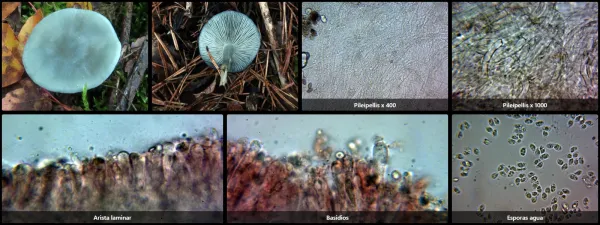
Clitocybe odora
Taxonomy
Main synonym
Common names
Anisada, anis-klitozibe berde, anisat.
Geographic references:
Interactive map with data from GBIF.




Morphological Features:
Pileus rarely exceeding 5 cm in diameter at full maturity, initially somewhat globose, soon becoming convex, and finally flattened, with the center occasionally slightly depressed or umbilicate in age. Blue-green when properly hydrated, but fading to olive-green, and may even become whitish upon drying. Surface smooth and slightly pruinose.
Lamellae adnate to slightly decurrent, grayish to pale greenish, much paler than the pileus. Quite crowded.
Stipe cylindrical and proportionate to the pileus, similar in color or somewhat paler. Smooth or weakly fibrillose.
Flesh thin, soft and lacking firmness, somewhat more fibrous in the stipe, whitish in color, with a sweet, overly cloying taste and a strong anise odor.
Habitat:
A very frequent and abundant species, fruiting equally under pines and in deciduous forests. Its preferred fruiting season is autumn, and in pine stands it is commonly observed growing in rows.
Observations:
We consider this species unmistakable; its greenish coloration and strongly anise-scented odor identify it perfectly, distinguishing it from any other Clitocybe. Clitocybe fragrans also smells of anise, but its stature is notably smaller, and it is more whitish.