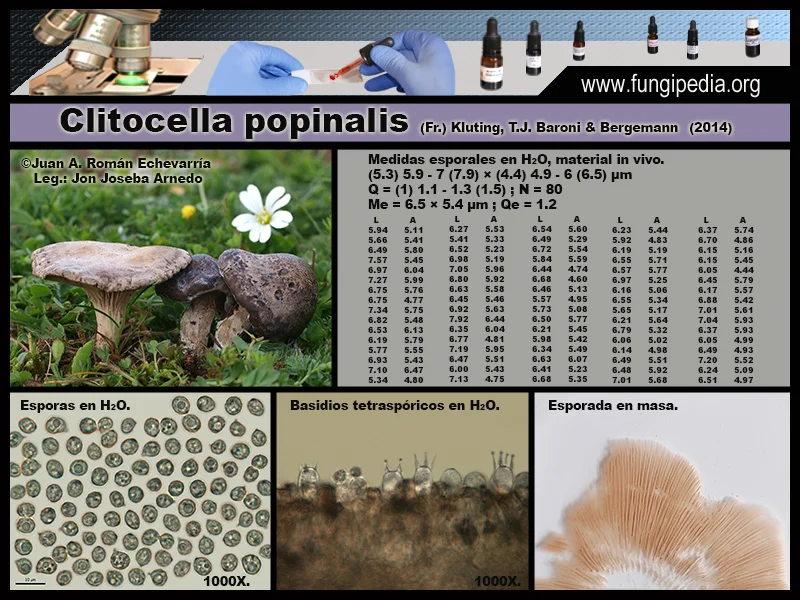

Clitocella popinalis
Taxonomy
Main synonym
Common names
Not available
Geographic references:
Interactive map with data from GBIF.
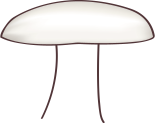
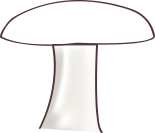


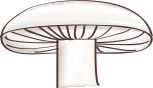
Morphological Features:
Pileus with a diameter ranging from 4 to 8 cm in adult specimens; hemispherical in the primordium stage, it quickly expands to become somewhat gibbous with a raised central zone, then flattens and may become slightly infundibuliform in older specimens. The cuticle is smooth and glabrous, dry, slightly tomentose, lacking uniform coloration as it characteristically displays a mottled pattern in various shades of gray, with many specimens also showing brownish or even lighter, creamy tones. Margin involute in early developmental stages, later extended and thin, not striate.
Lamellae rather crowded; somewhat decurrent in young specimens and becoming strongly decurrent with development, interspersed with lamellulae of varying lengths. Initially cream-colored, later turning grayish, though lighter in tone than the pileus. Lamellar edge entire and concolorous with the rest of the hymenium; spore print pinkish, staining the lamellae upon maturity.
Stipe well-proportioned, with a length similar to the pileus diameter; generally central, cylindrical or slightly attenuate towards the base when young. Whitish in youth, later becoming grayish as well, sometimes partially covered by a pruina that tends to darken upon handling.
Flesh relatively thick and firm, white in color; darkens slightly upon cutting to grayish tones, which may also appear at injury sites. It possesses a strongly farinaceous odor reminiscent of Calocybe gambosa to some extent, with a slightly bitter taste.
Habitat:
This species fruits in grasslands and high-altitude plains. It has been located for many years at various sites sharing a common denominator: open areas at moderate elevations, generally above 800 meters. Documented localities include Sierra de Cameros (La Rioja), Páramo de Masa (Burgos), Mataporquera (Cantabria), and Arauzo de Miel (Burgos). Fruiting occurs in both spring and autumn, typically in small groups of a few specimens, with a slight preference for basic soils. Bibliographically, it is considered an infrequent or scarce species.
Observations:
This species is characterized by its strongly decurrent lamellae, the mottled appearance in various shades of gray on its pileus, and above all, its strong farinaceous odor and slightly bitter taste. It is frequently confused with dark morphs of Pleurotus eryngii (king oyster mushroom), with which it often shares habitat; however, that species lacks the farinaceous odor characteristic of this one. Clitocella popinalis has been classified within the genus Rhodocybe for many years and synonymized with Rhodocybe mundula. Based on molecular studies, they are concluded to be distinct species, both now placed in Clitocella. Indeed, Clitocella mundula is typically more associated with forest habitats, exhibits a heavier pruina that fissures on the pileus, and possesses a more pronounced bitter taste. Although considered edible in some field guides, we regard it as inedible due to its poor flavor, and given its scarcity, it should not be collected.
Microscopy of Clitocella popinalis