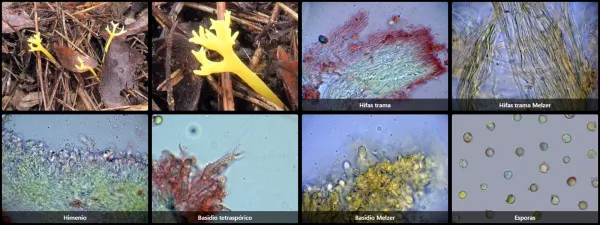

Clavulinopsis corniculata
Taxonomy
Main synonym
Common names
Adardun.
Geographic references:
Interactive map with data from GBIF.
Morphological Features:
Basidiocarp repeatedly branched in a bush-like manner, with these small branches being forked and some terminating in horn-like tips. It is not excessively large, reaching up to 7 cm in height at most, and no more than 5 cm in width. The surface is distinctly viscid, particularly during wet weather, and as it begins to dry, the tips turn reddish-ochre. Coloration ranges from a fairly bright yellow to orange, as occurs in all Clavulinopsis.
Hymenium immersed on the surface of the basidiocarp.
Stipe slender and very thin in some cases, concolorous; at other times it is not even apparent as such since the basidiocarp branches directly from the ground.
Flesh elastic in consistency and quite tough, yellowish in color. Odor is faint and taste slightly bitter.
Habitat:
Although its occurrence in other seasons cannot be ruled out, it is found most abundantly in autumn. However, it is not a widely distributed species; locally frequent but scarce in other areas. We have located it in grassy clearings within pine forests and on herbaceous meadows.
Observations:
The elastic consistency of its flesh and slightly bitter taste render it unsuitable for consumption, despite being non-toxic. Within Clavulinopsis, it is readily identified by its branched basidiocarps, a feature unique to the genus; however, it bears a notable macroscopic resemblance to Calocera viscosa, another viscid and branched species. The latter can be distinguished by its habitat on decaying conifer branches, and microscopically they are entirely distinct.