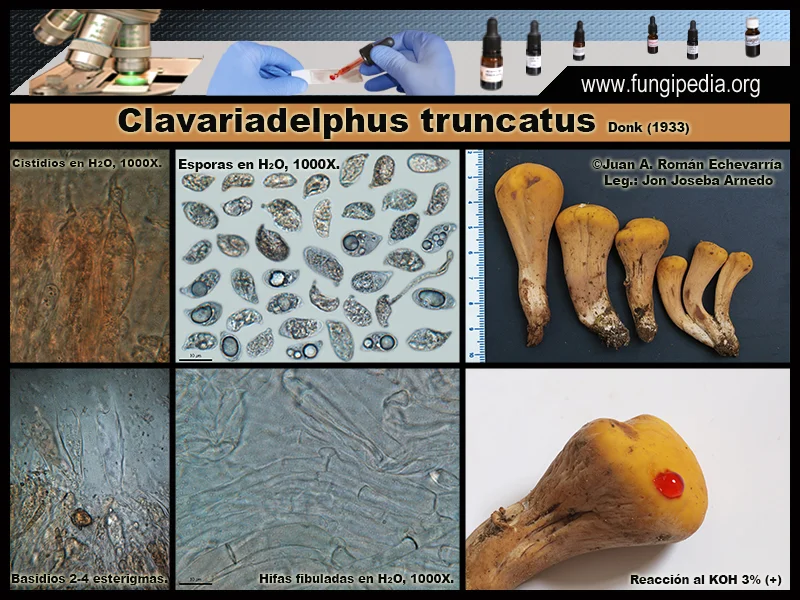
Clavariadelphus truncatus
Taxonomy
Main synonym
Common names
Mano de mortero truncado, chupetín, bossa truncada, Joiki gozo.
Geographic references:
Interactive map with data from GBIF.




Morphological Features:
Fruiting body with a characteristic mortar-hand or club shape, narrow towards the base and gradually widening towards the apex, where we find a much thicker zone, but which appears flattened right at the apex itself, often irregularly truncated. It usually attains a considerable size, typically between 5 and 15 cm in height by about 5 cm wide at the upper zone, although some specimens from our collection approached 20 cm in height. Its color is more vivid in young specimens, orange-ochre, becoming distinctly ochre and fading in mature specimens. Surface smooth at the base and more rugulose as we approach the apex, sometimes distinctly wrinkled in the truncated zone.
Hymenium located on the external surface of the fruiting body and covering the entire upper zone thereof, with a sterile zone towards the base.
Stipe truly absent, as the fruiting body constitutes a single unit without clear differentiation, although it is true that in mature specimens the fertile portion can be distinguished from the sterile one.
Flesh possessing a certain firmness in very young specimens, but quickly becoming spongy, white in color, and sometimes acquiring slightly ochraceous tones when cut. It has a very mild, insignificant odor, and a pleasant sweet taste, even sugary.
Habitat:
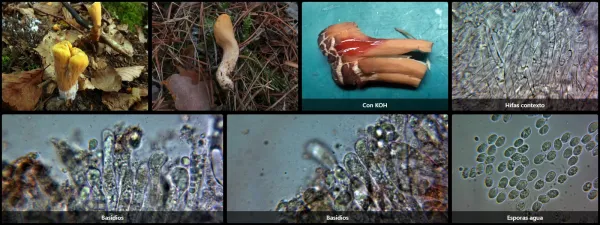
A species for which a somewhat cosmopolitan habitat is bibliographically referenced, it has been found in beechwoods, oakwoods, and pine forests; in our case, it was found in groups or fruiting clusters of numerous individuals under Pinus sylvestris in the province of Burgos. Our finding regarding the number of specimens observed is unusual, given that it is not usually too prolific, although in these pine forests at around 1000 m.a.s.l. it frequently appears. It is an eminently autumnal species; we have located it in all months of this season.
Observations:
It is characterized by its peculiar mortar-hand shape, with a flattened upper zone, the orange-ochraceous tone of the entire basidiocarp, and its sweet taste; for all these reasons, it is difficult to confuse with any other species. Clavariadelphus pistillaris is a notably similar species, but its apex is not flattened, rather rounded, and its taste is markedly bitter. It is considered a low-quality edible species; its high mannitol content gives it the characteristic sweetness, but the spongy and fluffy consistency of its flesh makes it by no means appetizing.
Microscopy of Clavariadelphus truncatus