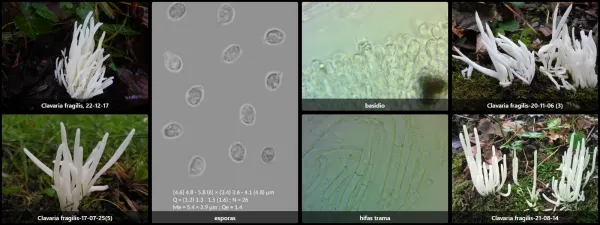

Clavaria fragilis
Taxonomy
Main synonym
Common names
Clavaria vermiforme, txixardin zuri.
Geographic references:
Interactive map with data from GBIF.

Morphological Features:
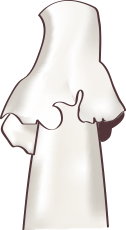
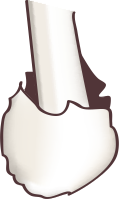
Fruiting body of pure white color, emerging from the ground clavate, resembling asparagus. The apical region is usually wider than the base, and it is laterally compressed. Most often it is not straight but curved, and generally occurs in clusters, sometimes united at the base, and other times with individual specimens grouped together. Only the tip yellows when the specimen is already very old due to necrosis. It usually exceeds 5 cm in height.
Hymenium smooth or slightly wrinkled, white in color, located on the external surface of the fruiting body.
Flesh scant; the mushroom quickly becomes hollow inside, very fragile and white in color, lacking any distinctive odor or taste.
Habitat:
Grows mainly during autumn, in meadows and grasslands, often hidden among the grass, so it usually goes unnoticed. This characteristic leads it to be considered a rare mushroom, uncommon; however, we believe it is not so rare, as we observe it every year without difficulty.
Observations:
Despite having no culinary value, it is pleasant to see in the field this pure white mushroom that contrasts with the green of the surrounding grass. Clavaria acuta or Clavaria falcata resemble it closely, but are somewhat smaller and do not grow in clusters. Clavaria fumosa does grow in clusters, but its color ranges from gray to leather-like.