
Clavaria acuta
Taxonomy
Main synonym
Common names
Clavaria con forma de aguja.
Geographic references:
Interactive map with data from GBIF.
Morphological Features:
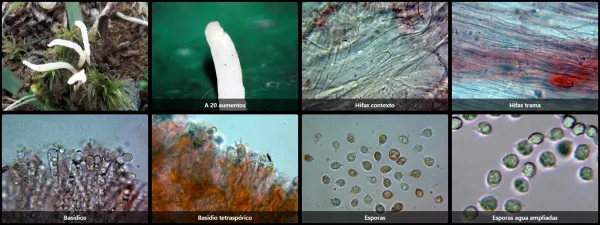
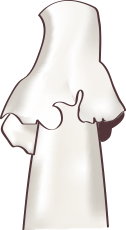
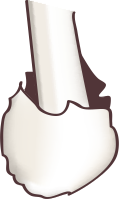
Basidiocarp slender and stylized, asparagus-like or needle-shaped; its height can easily exceed 5 cm, while its diameter is merely a couple of millimeters. The fertile surface of the reproductive body may occupy up to the upper two-thirds, being white, glossy when wet or otherwise more matte. The apex is usually rounded, rarely pointed, and of similar thickness to the rest or slightly narrower.
Hymenium immersed in the surface of the basidiocarp, smooth and concolorous.
Stipe occupying the lower portion of the basidiocarp, perfectly distinguishable from the rest macroscopically, whitish-gray in color with a translucent appearance. Its thickness is notably less than that of the upper region, practically reduced to half.
Flesh scarce and fragile, white in color; the basidiocarp is hollow. It has barely a perceptible odor and a mild taste.
Habitat:
Grows on the ground, on decomposed leaves of broadleaf trees, as well as in moist forest clearings and mossy areas; it is also described as occurring in meadows. It is a late-season species, found in autumn or early winter. It may appear solitary or in more or less numerous groups, but never fasciculate nor in bundles.
Observations:
This species is distinguished by its stylized appearance, white color, and the presence of a distinguishable stipe. It is very similar to Clavaria fragilis, which grows in lawns and grasslands, generally in bundles, and lacks a stipe distinguishable from the rest. Clavaria fumosa also grows in bundles and is leather-colored.