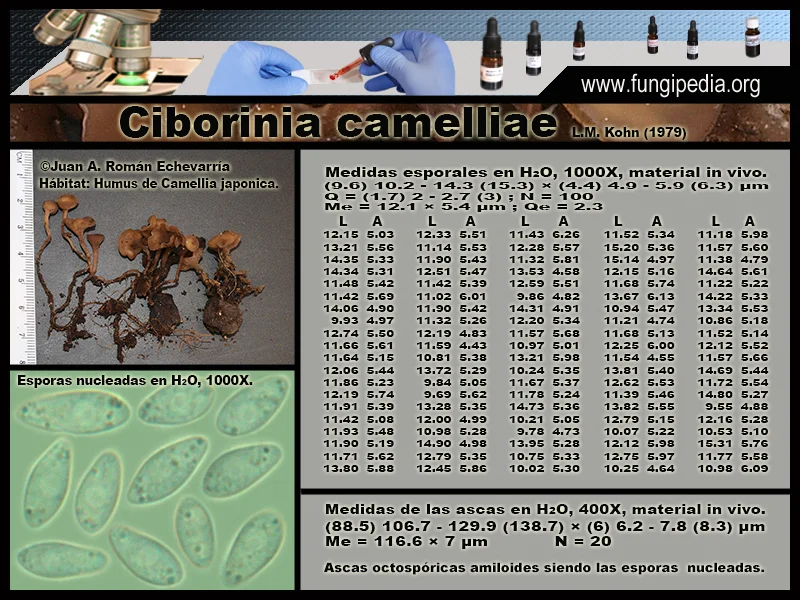

Ciborinia camelliae
Taxonomy
Main synonym
Common names
Patógeno de las Camelias
Geographic references:
Interactive map with data from GBIF.


Morphological Features:
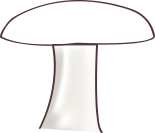
Carpophore resembling species of Ciboria, cupulate in the upper region and supported on a distinct stipe. In young specimens, this cup is more closed and pronounced, but tends to widen with development, eventually adopting a more irregular and lobed form in old age without becoming flattened, while maintaining an elevated margin. The size of this region is comparable to that of other similar species, ranging from 5 to 25 mm in diameter, with specimens approaching 30 mm occasionally found. Its color is somewhat variable within ochre to brown tones, from light ochre to dark brown, depending on environmental conditions or moisture levels, with the area near the margin appearing slightly translucent. Excipulum smooth or finely pubescent with a granular texture.
Hymenium smooth, lining the inner surface of the cup. It constitutes the fertile portion of the ascocarp, both the excipulum and stipe being sterile. Ochre to brown in color, similar to the excipulum, it contains uniseriate, eight-spored asci with a pleuroseptic base, amyloid, hyaline spores, and filiform paraphyses (see microscopy section).
Stipe well-differentiated, with a rough appearance and dark brown to blackish color. Fairly cylindrical and typically sinuous, rarely straight. Its length is highly variable depending on the substrate, ranging from a few millimeters to occasionally reaching 6 cm. It develops from a very firm, blackish sclerotium that contains both fungal structures and remnants of the decaying host flower.
Flesh quite hard and coriaceous in the stipe, and somewhat elastic elsewhere, without any distinctive odor or noteworthy taste.
Habitat:
This species is a pathogenic parasite of various Camellia species. The fungus directly affects the flowers, which drop prematurely upon infection. Once on the ground, a sclerotium forms on the petals, from which fruiting bodies develop and produce spores that, once dispersed, continue to infect additional flowers, completing the species' reproductive cycle. It appears to be a biotrophic parasite that weakens but does not kill the host, affecting only the flowers. Throughout the northern Iberian Peninsula, it is a fairly widespread species; in our region, it parasitizes Camellia japonica, an ornamental species found in gardens throughout the area.
Observations:
All species of the genera Ciboria, Ciborinia, Sclerotinia, etc., develop macroscopically very similar ascocarps; therefore, it is essential to first identify the host plant and conduct a thorough microscopic examination for accurate identification. The species under consideration is characterized by its exclusivity to camellias. It was originally classified as Sclerotinia, but was later transferred to Ciborinia due to factors such as its sclerotium containing host plant elements, which does not occur in Sclerotinia. Additionally, it does not produce white mycelial growth, and unlike species of Sclerotinia, it does not kill the host plant.
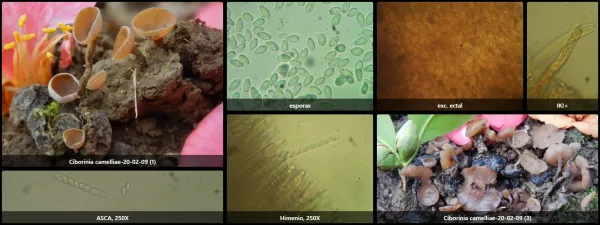
Microscopy of Ciborinia camelliae