
Ciboria coryli
Taxonomy
Main synonym
Common names
Ciboria de los avellanos.
Geographic references:
Interactive map with data from GBIF.



Morphological Features:
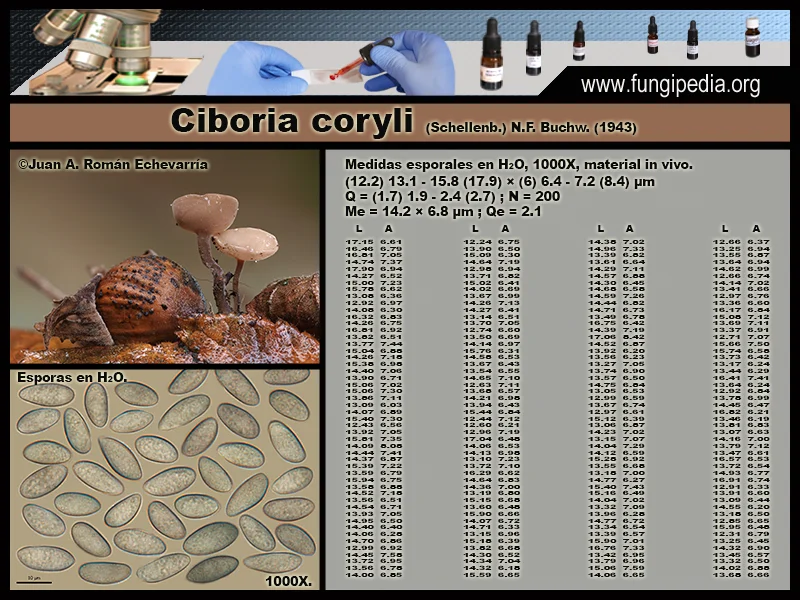
Cap of quite small size, similar to other Ciboria species we have published, it can reach a diameter of 15 mm at the upper region. It has a cup-like shape, being more closed in young specimens and tending to open with development, although it usually does not flatten completely, as it always maintains raised margins. The external surface is the non-fertile zone of the carpophore; it usually exhibits a highly variable color depending on the degree of moisture, developmental stage, and depth of burial in the substrate, ranging from dark brown to grayish cream. It is typically covered, to a greater or lesser extent, by a whitish tomentum, which may disappear completely or partially following rainfall. The margin is usually regular, although it is not uncommon for it to show some fissures or become slightly lobed.
Hymenium inserted on the internal surface of the cup, similar in color or slightly lighter than the external surface, smooth and glabrous; it usually lacks the typical tomentum of the exterior, although it is sometimes slightly granular. It produces irregularly elliptical spores larger than those of other congeners, predominantly binucleate, and asci with croziers at their base.
Stipe longer than the diameter of the cup, generally between 2 and 3 cm in length, but more deeply buried specimens develop longer stipes, up to 6 cm. It has a more or less dark brown color, is wider near the cup, tapering towards the base; rarely straight, more commonly sinuous. It is usually coated with the same tomentum found on the external zone of the cup, particularly towards the apex.
Flesh insignificant and somewhat elastic, without any characteristic odor and completely tasteless.
Habitat:
This is a species characterized by its fruiting on old hazel catkins (Corylus avellana); occasionally, it may be found on rotting fruits from the previous year. It is not a highly prolific species, although where it occurs, it typically does so in more or less numerous groups. It is a cold-loving species, with its preferred fruiting period being late winter to early spring, between February and April, in areas with high moisture or occasionally muddy conditions.
Observations:
Species of the genus Ciboria are very difficult to differentiate macroscopically due to their high similarity; identification requires attention to the substrate on which they develop, as well as microscopic analysis. Ciboria amentacea can be distinguished by its smaller, uninucleate spores; although occasionally collected on hazel, it typically fruits on alder catkins (Alnus glutinosa). Ciboria caucus is smaller, as are its spores (less than 11 μm); it also typically occurs on alders, although it is more cosmopolitan. Ciboria batschiana grows on old oak or chestnut fruits. Ultimately, Ciboria coryli is characterized by its fruiting on hazel catkins and its large, binucleate spores.
Microscopy of Ciboria coryli