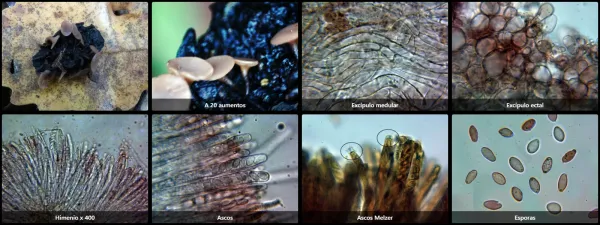

Ciboria batschiana
Taxonomy
Main synonym
Common names
Not available
Geographic references:
Interactive map with data from GBIF.
Morphological Features:
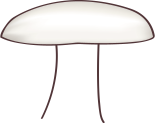
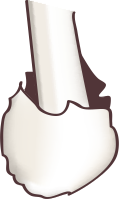
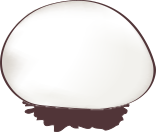
Pileus of small dimensions; fully developed individuals barely reach a diameter ranging from 0.5 to 2 cm. Initially hemispherical in early stages, it gradually flattens over time, eventually becoming more or less plane while retaining an umbilicate depression at the center. The external non-fertile surface is dark brown, almost tawny, completely smooth, and the margin is sharp and regular, slightly to not at all crenate.
Hymenium smooth, matching the color of the external surface or slightly paler.
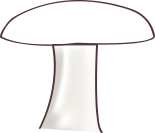
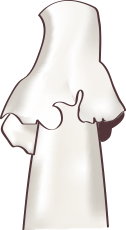
Stipe very prominent; when the substrate is buried it can be quite long, reaching about 3 cm, although typically measuring 1 to 2 cm. It is more robust than the pileus, and its color is dark, practically blackish.
Flesh scant, waxy-textured in the pileus, harder and more fibrous in the stipe. Its odor is barely perceptible, and its taste is mild.
Habitat:
The photographed specimens were found fruiting on sessile oak acorns (Quercus petraea) in the province of Cantabria. Some authors also note its possible occurrence on decaying chestnuts. They were located in October, leading us to consider it an autumnal species. We regard it as a difficult species to locate due to its small size and the fact that it is mostly buried upon emergence; it is also highly localized, although where it does occur, it appears abundantly.
Observations:
This is an Ascomycete notable for its peculiar habitat on oak or chestnut fruits. A species with similar characteristics exists, Ciboria amentacea, which differs by fruiting on alder catkins and is more distinctly cupuliform with a finely serrate margin. It also resembles Rutstroemia firma, which grows on decaying oak wood.