
Ciboria amentacea
Taxonomy
Main synonym
Common names
Not available
Geographic references:
Interactive map with data from GBIF.



Morphological Features:
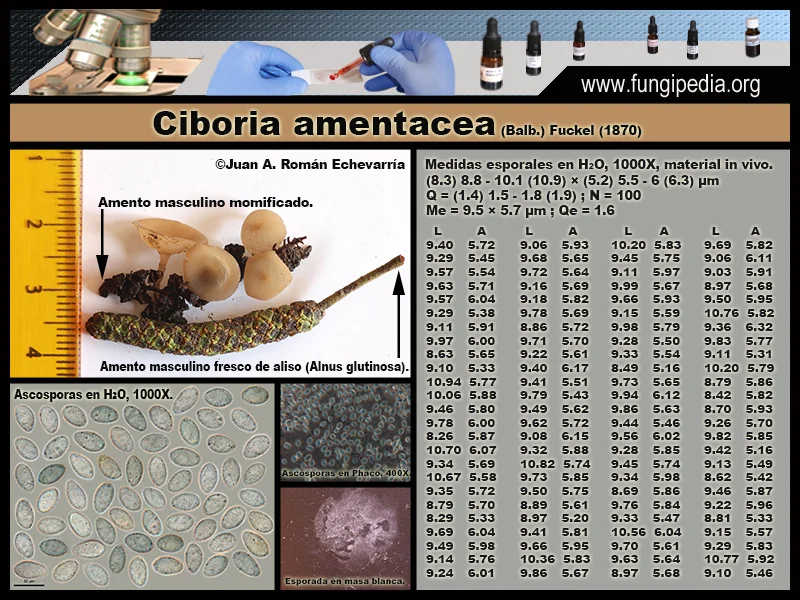
Pileus very small in size, at best barely reaching 1 cm in diameter. Its typical form is that of a more or less open calyx or cup, especially when young apothecia, but with age it tends to flatten until practically discoid and slightly umbilicate at the center. The fresh color of its external surface is beige, lightening as it loses moisture to sometimes become whitish cream, and it is additionally finely scurfy. The margin is usually very finely toothed, although in very young specimens it may be smooth.
Hymenium smooth, located inside the cup, ochre in color, lighter or darker depending on the specimen's moisture content.
Stipe longer or shorter depending on the position of the substrate upon which it fruits; on superficial catkins the stipe is short, and if growing on deeply buried catkins, specimens with a stipe approaching 5 cm in length have been observed. The color is similar to that of the external surface, lighter than the hymenium.
Flesh insignificant, waxy in appearance, with no characteristic odor or flavor worthy of mention.
Habitat:
This ascomycete generally fruits in clusters on old alder catkins, sometimes apparently on the soil when these are buried. Its fruiting period varies depending on climatic conditions; it may appear as early as February during very mild winters or wait until April. It is not a rare species, but its habitat and fruiting period are highly specific.
Observations:
A similar species fruits on poplar catkins, Ciboria caucus, considered by some authors as a synonym of the present species. Another species with similar characteristics, associated in this case with trees of the genus Quercus, is Ciborinia candolleana, which emerges from a minute sclerotium. Also commonly encountered are Ciboria batschiana on oak or chestnut fruits, and Ciboria coryli under hazel bushes. Other genera may also be confused with the species described here, such as Sclerotinia or Rustroemia.
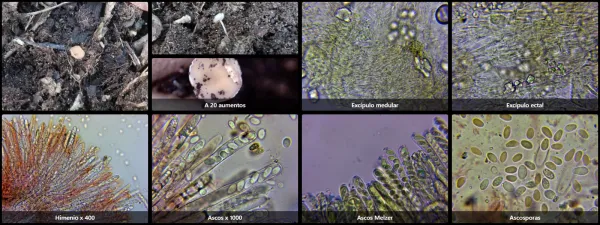
Microscopy of Ciboria amentacea