
Chromosera viola
Taxonomy
Main synonym
Common names
Hygroforo violeta
Geographic references:
Interactive map with data from GBIF.



Morphological Features:
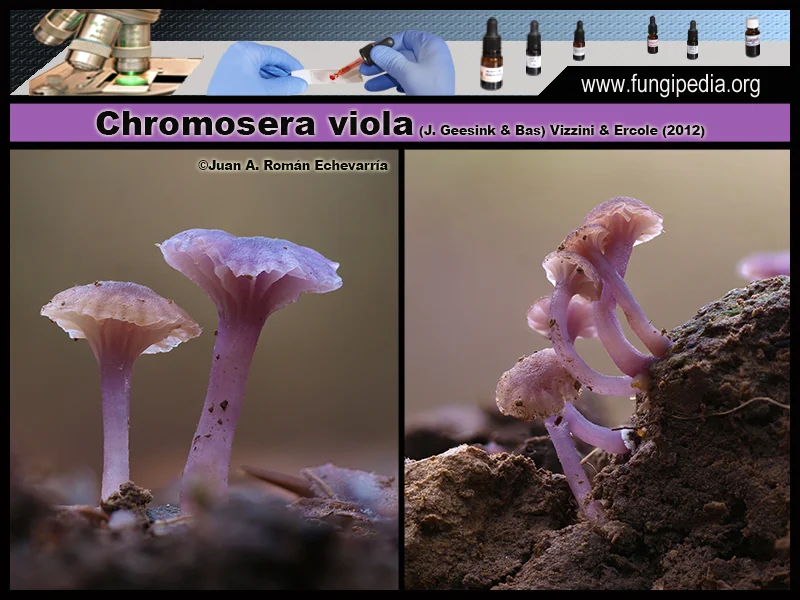
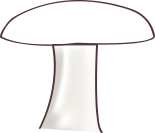
Pileus of small dimensions, with specimen diameters ranging from 0.5 to 2.5 (3) cm. Color is fairly uniform, though the center may occasionally take on a slightly darker shade; however, it varies depending on moisture levels, ranging from pink or salmon to lilac or violet. Highly conspicuous, fading upon drying. Young specimens are somewhat convex to plano-convex, later becoming flattened, and finally slightly depressed. Surface smooth and glabrous, with a glossy appearance and slightly viscid in wet conditions, otherwise dry. Margin somewhat crenulate and deeply striate across almost the entire surface, except for a small central area.
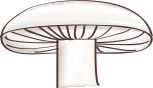
Lamellae strongly decurrent on the stipe, exhibiting the typical waxy appearance characteristic of species within its genus. They are widely spaced with some lamellulae intercalated. Same color as the pileus, uniform, with an entire and concolorous edge; they may occasionally be somewhat intervenose, though this is a variable character.
Stipe cylindrical and elongated, potentially twice as long as the pileus diameter, centrally attached, though sometimes tending to narrow basally. Color analogous to the rest of the basidiome, smooth or slightly fibrillose. May become somewhat viscid in wet conditions, similar to the pileus.
Flesh scant and invariable both upon cutting and bruising, fragile, virtually absent in the pileus, fibrous in the stipe, with a color similar to the outer surface of the basidiome. Odor mild and indistinct; taste neutral.
Habitat:
This species represents a "rara avis" within its genus, as other Chromosera species typically fruit on woody debris or directly on wood, whereas this one is strictly terrestrial. Specimens were collected by Juan Andrés Román on a mossy slope within an acidophilous beech forest in Altube (Araba). It typically appears in more or less numerous groups during autumn or early winter; it is a very uncommon species and therefore warrants protection.
Observations:
Taxonomically, this species has been placed in several different genera, from Omphalina to Hygrocybe, before being reassigned to Chromosera based on phylogenetic studies. The genus currently comprises only five species. Due to the uniform and strikingly beautiful coloration of the entire basidiome, along with its suite of macroscopic characteristics, it is a species that is hardly confused with others, although some Hygrocybe species, such as Hygrocybe calyptriformis, do exhibit pinkish tones.
Microscopy of Chromosera viola