Choiromyces meandriformis
Taxonomy
Main synonym
Common names
Txerri-grisola.
Geographic references:
Interactive map with data from GBIF.





Morphological Features:
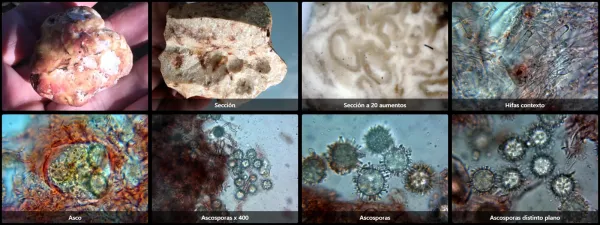
Fruiting body of substantial size; among hypogeous or semi-hypogeous Ascomycetes, it is one of the largest species. Its diameter can occasionally exceed 10 cm, though it is typically found between 5 and 8 cm in diameter. It has a tuber-like shape, rarely round or uniform, but rather irregular with prominences, or it can also be described as truffle-shaped.
Peridium smooth and non-dehiscent, yet irregular, as maturation causes an enlargement of the gleba that frequently leads to cracking of the peridium. It is creamy-white in color, especially when young, turning to grayer tones and subsequently adopting an ochraceous or even reddish-brown hue when very old.
Stipe absent.
Gleba compact and solid, creamy in color, turning yellowish with age. Throughout its flesh, it is traversed by whitish veins with a typical meandering pattern, which gives the species its name; these veins become more prominent upon drying of the specimen. The taste of this species is unremarkable, and when young it is practically odorless, but upon maturation it develops a very strong and characteristic odor that is difficult to define, reminiscent of tomato concentrate, which proves unpleasant.
Habitat:
Although it can be found completely buried, i.e., hypogeous, the species typically emerges to the surface, classifying it as a semi-hypogeous fungus. It can be found from spring well into autumn, occurring equally under conifers and broadleaf trees, with a preference for alkaline soils. It is a frequent species, but due to its concealed growth habit, it is not easy to locate.
Observations:
Precautions must be taken with this species, as it is considered toxic due to its strong purgative properties and its tendency to cause gastric disturbances similar to gastroenteritis, including severe diarrhea. However, there exists a morphologically similar species that is edible and commonly collected in certain provinces of southern peninsular Spain: Terfezia magnusii=Choiromyces magnusii, a somewhat smaller spring-fruiting species whose veins do not form meandering patterns, and which grows exclusively under rockroses (Cistus sp.).