
Chlorociboria aeruginascens
Taxonomy
Main synonym
Common names
Gardinga.
Geographic references:
Interactive map with data from GBIF.




Morphological Features:
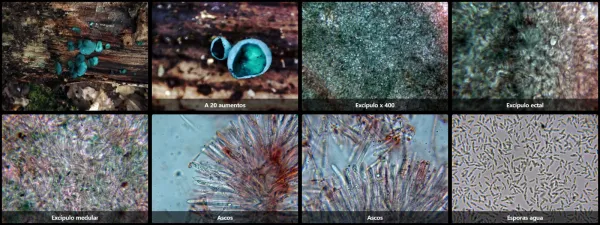
Fruiting body of very reduced dimensions, barely reaching 5 mm in diameter by the same in height at best. Its shape varies throughout development, being convex when young, but flattening out over time. Color is the most striking feature of the species, and what prevents them from going unnoticed despite their small size; they exhibit a very conspicuous blue-green hue. The external surface is furfuraceous, making the blue-green color slightly more matte than on the hymenium.
Hymenium smooth, of intense blue-green color.
Stipe very short in young specimens, practically imperceptible when the specimen flattens out. Same color as the rest of the fruiting body.
Flesh barely perceptible and insignificant, as is its odor and taste.
Habitat:
A fairly common species during summer months and early autumn, growing in numerous associated individuals, sometimes crowded together. Its habitat consists of fallen branches from various broadleaf trees, especially if they are barkless or decaying because they fell the previous winter. It is commonly found on the portion of the branch in contact with the soil, where higher moisture is retained.
Observations:
This small species draws attention due to its blue-green color; otherwise, it can be considered unmistakable. Of course, this holds true provided we do not consider the possibility of the existence of Chlorosplenium aeruginosum, which according to some authors differs from it by having more elongated spores. However, it remains unclear whether it constitutes a distinct taxon or merely reflects spore size variability under certain environmental conditions.