
Cheilymenia stercorea
Taxonomy
Main synonym
Common names
Not available
Geographic references:
Interactive map with data from GBIF.



Morphological Features:
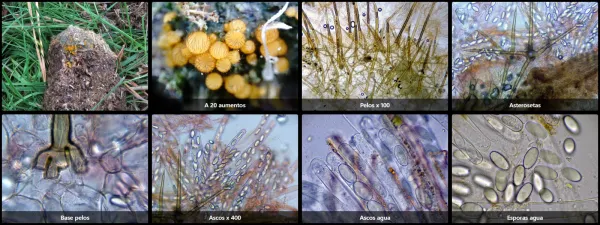
Fruiting body of minute size; at best, its diameter barely reaches 2 to 3 mm. Initially concave or slightly cup-shaped during early developmental stages, it evolves to become practically discoid and flattened. The external surface color ranges from light to intense orange and is covered with hairs that become more prominent toward the margin, extending in a bristly manner. These marginal hairs are also darker and longer; in some cases, they may reach up to 1 mm in length. It is common for these excipular hairs to be branched in a stellate pattern.
Hymenium smooth, with a color similar to the external surface but lacking the hairs present on it.
Stipe absent; this is a sessile species.
Flesh fragile and insignificant, with a waxy appearance; no noteworthy odor or flavor can be detected.
Habitat:
This is a coprophilous Ascomycete; it always fruits on dung, with a preference for bovine manure. It is a gregariously fruiting species that forms substantial colonies on dung pats. Under favorable conditions, it may appear practically year-round. It is a frequent species that often goes unnoticed due to its minute size.
Observations:
The genus Cheilymenia comprises very small species that are cup-shaped or spatulate, with vivid yellowish, orange, or reddish colors, and they share the common feature of hairs on the exciple. Scutellinia crucipila is very similar, also possessing stellate hairs, but has a more terrestrial habitat. Many other species share similar macroscopic characteristics, necessitating a detailed microscopic analysis for accurate identification.