Chamaemyces fracidus
Taxonomy
Main synonym
Common names
Lepiota manchada
Geographic references:
Interactive map with data from GBIF.





Morphological Features:
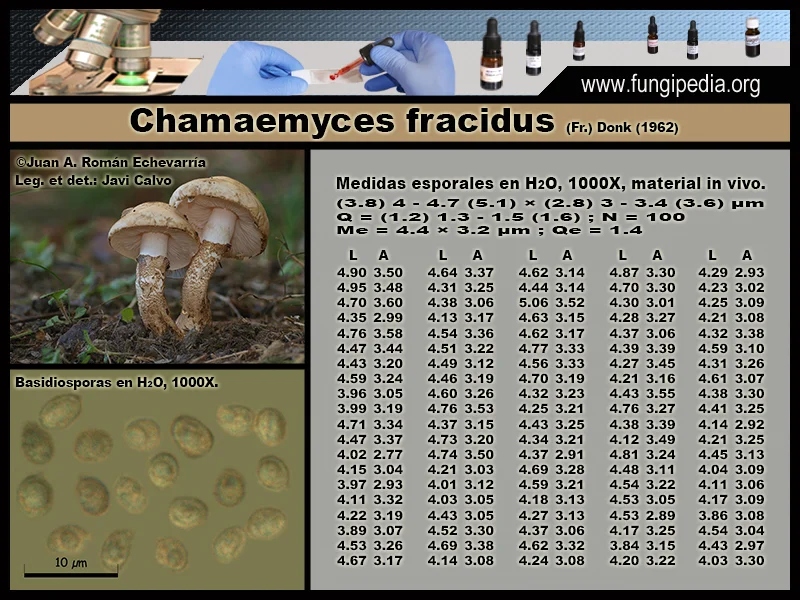
Pileus initially globose over the stipe in its primordial state, but as it develops becomes somewhat campanulate, then convex, and finally plano-convex, without becoming infundibuliform; some specimens have a raised center without forming an umbo. It has a diameter ranging from 5 to 8 cm in adult specimens, and a cuticle that is lubricous in rainy weather, otherwise appearing rather dry and somewhat silky, predominantly cream-colored in our collection, but occasionally adopting ocraceous tones, especially towards the center. This cuticle may bear somewhat randomly distributed macules, or simply lack them; the margin is slightly incurved when young, sometimes bearing floccose remnants that tend to disappear later. Very young specimens may exhibit amber-colored droplets on the margin.
Lamellae dense, rather crowded, somewhat irregular; some appear straight, while others are often sinuate or even ventricose. Initially white, becoming more cream-colored at maturity. The spore print is cream-white. Attachment to the stipe ranges from free to subfree, occasionally attached by a tooth.
Stipe generally cylindrical and proportionate in length to the pileus diameter, sometimes slightly attenuated towards the base. White in the upper third, followed by a perfectly delimited annular zone in most specimens. From this point down to the base, it appears brownish-punctate due to the drying of amber-colored exudates produced by the species; these exudates are frequently visible on the stipe itself.
Flesh rather compact and fibrous, white in color, practically unchanged on cutting except at the stipe base where it may acquire pinkish hues. It appears quite insipid in taste and possesses a characteristic, not overly pronounced odor that, contrary to its etymology, does not seem unpleasant to us.
Habitat:
This is a species fairly widespread across the European continent, yet paradoxically highly localized, leading us to classify it as infrequent or scarce; in certain Nordic countries, it is listed as endangered. Bibliographically, highly disparate habitats are cited for it, ranging from coastal pine dunes to meadows or roadsides. Autumn is typically its preferred season of fruiting, and it commonly grows in small groups. Our collection was made in the Gorbeia Natural Park, Ubide (Bizkaia), comprising several groups of specimens in a grassy area beside a forest track, also near a riparian woodland, during the months of October and November.
Observations:
A species that shares many affinities with the genus Lepiota, and whose macroscopic appearance may also strongly recall the genus Cystoderma, particularly due to the decoration of its stipe. However, this patterning results from the drying of exudates, rather than from possessing a universal veil remnant as seen in species of the aforementioned genus. In any case, it is a rather peculiar species and difficult to confuse with others. There does exist an even rarer species, Chamaemyces pseudocastaneus, which was formerly cited as a variety of Chamaemyces fracidus; molecular sequencing confirmed it to be a distinct species, characterized by a chestnut-brown pileus, a less decorated stipe, and an overall drier appearance.
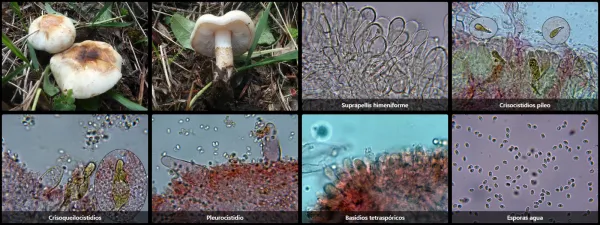
Microscopy of Chamaemyces fracidus