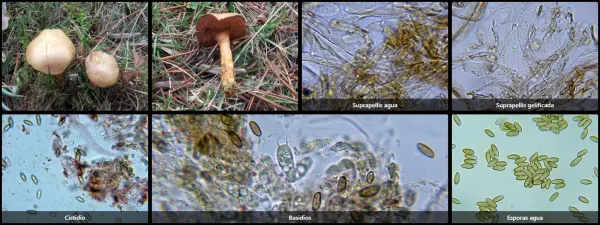

Chalciporus piperatus
Taxonomy
Main synonym
Common names
Boleto picante, piper-onddo, pebreta.
Geographic references:
Interactive map with data from GBIF.

Morphological Features:
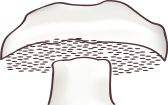
Pileus in the adult stage measures 3–6 cm in diameter, very occasionally somewhat larger. Initially hemispherical, but soon becomes convex, a shape it maintains throughout most of its development; only towards maturity does it become plane-convex, and complete flattening is very rare. The cuticle is slightly viscid when wet but generally dry; when young and in pristine condition, it exhibits a characteristic ochre color with cinnamon tones. With age or under excessive moisture, it becomes more brownish and even somewhat yellowish. Margin slightly excurrent and irregularly undulate.
Tubes adnate and quite long relative to the small size of the fruitbody; yellow when young, turning reddish-ochre or cinnamon.
Pores angular and relatively wide, reddish-ochre or cinnamon in color; they may acquire an orange hue with age and under certain environmental conditions.
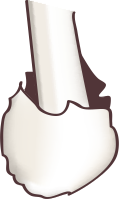
Stipe proportionate or slightly elongated, yellowish with brownish tones; typically curved or sinuous and attenuated at the base, appearing solid relative to the specimen size. Its most notable feature is the base, which is conspicuously stained saffron-yellow.
Flesh somewhat compact when young, becoming spongy with age; yellow throughout, though it takes on a pinkish tinge beneath the cuticle and is a brighter yellow at the stipe base. Odor barely perceptible; in contrast, taste is markedly pungent.
Habitat:
This species does not form mycorrhizae with a specific host tree; it should be noted that it is rare under broadleaf trees but common in coniferous forests. We have located it under Japanese larch (Larix kaempferi) and also under Scots pine (Pinus silvestris). Its preferred fruiting season is autumn, though it has also been observed during rainy springs.
Observations:
This mushroom should be rejected for consumption, as its flesh possesses an extremely pungent taste that becomes unpleasant. The recently classified rare species Chalciporus hypochryseus is virtually identical, except for having yellow pores. The species with which it is most easily confused is also much rarer, Chalciporus amarellus, which has pinkish pores and flesh that is bitter rather than pungent.