

Cerioporus squamosus
Taxonomy
Main synonym
Common names
Poliporo escamoso, ardagai ezkatatsu-handi, bolet de noger.
Geographic references:
Interactive map with data from GBIF.




Morphological Features:
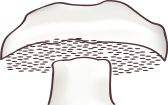
Pileus very large; specimens approaching 50 cm in diameter have been collected, although it is usual for them to reach between 25 and 35 cm when fully developed. It is dimidiate or kidney-shaped, laterally attached to the substrate via a small stipe. The background color is yellowish-ochre, but it is entirely covered by more or less thick scales of a darker ochre hue with a fairly regular distribution. The margin remains involute for some time before becoming expanded and thin. The entire pileus has a very fleshy appearance.
Hymenium composed of short tubes with lacerate walls that are notably decurrent onto the stipe; they are ochraceous in color. The pores are of the same color or slightly lighter, measuring 1 to 2 per mm and having a rather angular shape.
Stipe variably positioned, eccentric or lateral, and occasionally central; short, solid, and fleshy. Initially whitish, it gradually turns black starting from the base, becoming entirely black in older specimens.
Flesh thick near the substrate attachment, up to 5 cm thick in some cases, becoming thin toward the margin; light ochre in color. In young specimens it is soft and spongy, later becoming leathery with a corky texture. The taste is sweet and pleasant, whereas the odor is somewhat strong, reminiscent of rancidity.
Habitat:
This species invariably fruits on dead wood of various trees, or on living trees in obvious decline, particularly deciduous ones. It may appear from spring through late autumn. It is a rare species in our region but frequent elsewhere.
Observations:
Very young specimens may be consumed with some pleasure, but they quickly become leathery, making it a mushroom not particularly suitable for culinary use. It is a species characterized by its large size and scaly pileus, which we consider clearly distinguishes it from other species in its genus. Nevertheless, we will highlight Polyporus tuberaster, as it also possesses a scaly cap, albeit being much smaller.