Ceratiomyxa fruticulosa
Taxonomy
Main synonym
Common names
Not available
Geographic references:
Interactive map with data from GBIF.




Morphological Features:
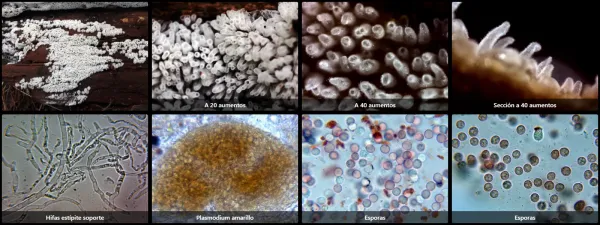
Plasmodiocarp showing some variability in shape and color; in the type species under consideration, it is formed by the aggregation of multiple tiny horns barely 5 mm tall. They are whitish and translucent, almost transparent, often growing erect and solitary, and at other times branched. They adhere to the substrate forming masses that can be quite extensive. The variability of this species has given rise to several varieties.
Spores smooth and hyaline, more or less ovoid in shape, forming directly on the white horns; it is therefore an exosporous species. Upon germination, a structure containing four nuclei forms, followed by double cleavage yielding eight uninucleate cells that develop small appendages known as flagella. These fuse in pairs to form zygotes, which will give rise to a new plasmodium.
Stipe Absent; it is a sessile species.
Flesh Insignificant, with a gelatinous consistency, particularly during rainy periods.
Habitat:
It appears practically year-round provided conditions are favorable, always attached to the wood of various broadleaf trees, particularly on decaying wood. It is primarily found under beeches. Due to its small size, it often goes unnoticed, but it is a frequent species.
Observations:
We present the type species of the only genus among Myxomycetes whose spores form in an exosporous manner, lacking a peridium. We consider it an unmistakable species given its peculiar characteristics, both microscopic and macroscopic. The var. porioides, currently recognized as an independent species, forms structures resembling pores, whereas var. caesia is bluish.